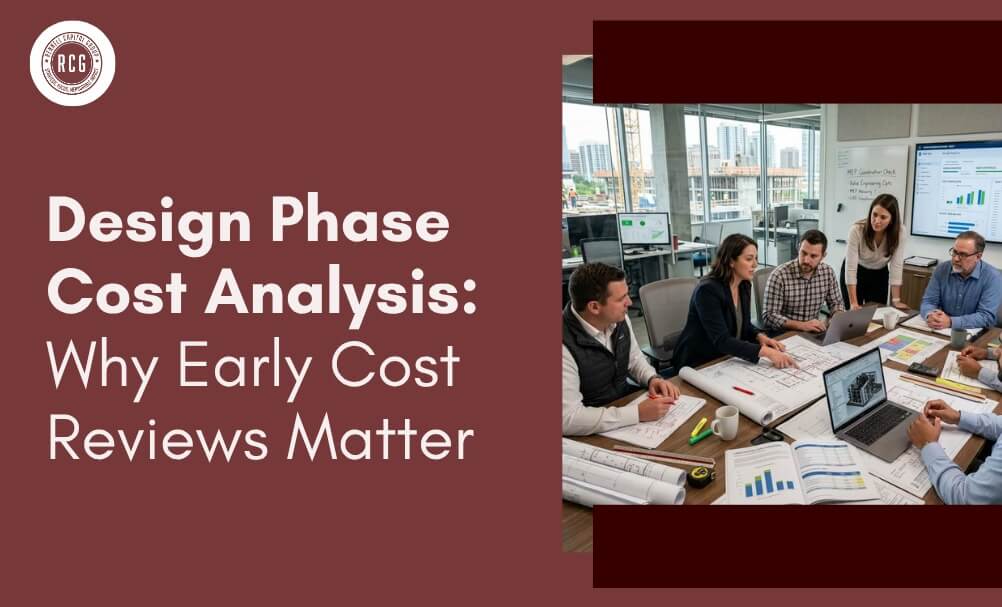
Most construction budget problems don’t start on the job site. They start at the drawing board. A scope gap which slips through design may balloon into a six-figure change order once crews are pouring concrete.
That’s why design phase cost analysis has become one of the smartest investments an owner, developer, or contractor can make. By evaluating costs while drawings are still flexible, you catch problems when fixing them is cheap; not when it’s painful. Industry pressure to deliver projects on time and on budget has never been higher, and early cost reviews give project teams a real shot at meeting both goals.
In this guide, you’ll learn what design phase cost analysis involves, why early cost reviews matter so much, and how each phase of the process protects your budget. You’ll also see how owners, developers, and contractors each benefit, and why bringing in professional cost consultants sharpens the accuracy of every review.
What Is Design Phase Cost Analysis?
DDesign phase cost analysis is the practice of evaluating a project’s costs as the design develops, rather than waiting until construction documents are complete.
It sits at the heart of preconstruction planning. As architects and engineers refine drawings, cost professionals track how each decision affects the bottom line. This keeps the project’s vision and its budget moving in the same direction.
Quick definition: Design phase cost analysis is the process of reviewing and forecasting construction costs throughout design development to improve budgeting, reduce risk, and support better decisions before construction begins.
The relationship to project budgeting is direct. Rather than you treating budget as a fixed number you hope to hit, this approach treats it as a living target you actively manage. Every design choice, from structural systems to finishes, gets weighed against its cost impact.
Why Early Cost Reviews Matter
When cost reviews happen late, owners lose ability to make meaningful changes. The design is created, contracts are even signed, and only path forward is cutting quality or absorbing overruns.
Here’s what early reviews deliver:
- Budget certainty: You know where you stand at each design milestone, so there are no nasty surprises at bid time.
- Risk reduction: Cost issues surface while they’re still easy and inexpensive to address.
- Proper decision-making: Stakeholders may compare options with real stats or numbers, not guesses.
- Stronger stakeholder confidence: Lenders, investors, and boards trust projects backed by disciplined cost control.
Consider a developer who skips early reviews on a multi-tenant redevelopment. The design looks great, but no one checked the cost of the specified mechanical systems against the budget. When bids come back 20% over, the project stalls while the team scrambles to redesign. Months are lost. Compare that to a project where cost analysis flagged the issue during design development—a quick swap to a more economical system kept everything on track.
These stories repeat across the industry. Delayed cost reviews don’t just cost money; they cost time, momentum, and credibility.
The Role of Design Phase Cost Analysis in Preconstruction Planning
Preconstruction is where projects are won or lost financially. Design phase cost analysis ties together four key activities during this stage.
Design development. As schematic drawings evolve into detailed plans, cost analysis tracks how each refinement affects spending. This creates a feedback loop between designers and the budget.
Cost forecasting. Rather than waiting for final numbers, teams project costs based on the current design. Reliable project cost forecasting helps owners secure financing and plan cash flow with confidence.
Scope evaluation. Every project needs a clearly defined scope. Cost analysis pressure-tests the scope, exposing gaps and ambiguities before they turn into disputes.
Financial planning. Accurate early estimates feed directly into construction financial planning, helping owners and developers structure funding and set realistic expectations.
When these pieces work together, projects move from design to construction smoothly because the budget and the plans are already aligned. This is the foundation of solid construction cost planning.
Key Components of Design Phase Cost Analysis
A thorough analysis is built from several distinct activities. Each one targets a specific source of budget risk.
Conceptual Cost Estimating
Conceptual cost estimating is the starting point. Before detailed drawings exist, cost professionals build preliminary estimates using historical data, square-foot costs, and project benchmarks. These early budgeting figures help owners decide whether a project is feasible and set a realistic financial target.
Quantity Takeoff Reviews
As designs mature, quantity takeoffs measure the materials, labor, and equipment the project will require. Reviewing these takeoffs catches errors in material quantities, tests labor assumptions, and confirms equipment needs. Accurate takeoffs are the backbone of design development estimating, get them wrong, and every downstream number is off.
Scope Validation
Scope validation makes sure the design actually covers what the project requires. It identifies gaps, clarifies fuzzy requirements, and guards against scope creep, the slow expansion of work that quietly drains budgets. Catching a missing scope item during design costs almost nothing.
Market Pricing Evaluation
Numbers from last year don’t hold up in today’s market. Market pricing evaluation checks current material price trends, regional labor costs, and supply chain conditions.
Risk and Contingency Assessment
Every project carries risk. This component identifies design risks, budget risks, and potential schedule impacts, then sets appropriate contingencies. A well-built contingency isn’t padding; it’s a calculated buffer based on the project’s specific risk profile.
How Design Phase Cost Analysis Improves Project Outcomes
The payoff from early cost analysis shows up across the entire project lifecycle.
- Better budget control: Costs stay within the approved budget because issues get caught early.
- Fewer change orders: Resolving conflicts during design dramatically cuts the changes needed during construction. One RCG client saw change orders drop by 15% after a thorough cost and scope review.
- Improved scheduling: Fewer surprises mean fewer delays, keeping the project on its timeline.
- Enhanced profitability: Tight cost control protects margins for contractors and returns for developers.
- Stronger project performance: Projects with disciplined cost management consistently outperform those that skip it.
Strong cost control strategies don’t just save money, they make the whole project more predictable, which is exactly what every stakeholder wants.
Common Cost Risks Identified During Design Reviews
Design reviews routinely surface risks that would otherwise stay hidden until construction. The most common include:
- Incomplete drawings: Missing details lead to assumptions, and assumptions lead to cost overruns.
- Design changes: Late revisions ripple via budgets and schedules.
- Scope gaps: Work that nobody priced because nobody noticed it was truly missing.
- Pricing volatility: Some shifts in material or labor costs which blow up outdated estimates.
- Coordination issues: Clashes between architectural, structural, and MEP systems that trigger expensive rework.
Spotting these during design when a drawing can be revised in hour, beats discovering them on site, where the fix involves crews, equipment, and lost time.
The Relationship Between Cost Analysis and Value Engineering
Cost analysis and value engineering services work hand in hand. Once analysis reveals where the budget is strained, value engineering finds smarter ways to deliver the same function for less.
This isn’t about cheapening the project. It’s about cost optimization in construction identifying material alternatives, improving design efficiency, and weighing long-term value against upfront cost. A more efficient HVAC layout might cost the same to install but save thousands in operating expenses over the building’s life.
The best value engineering happens during design, when changes are still easy to make. Pair it with solid cost analysis, and you get a project that delivers maximum value for every dollar spent.
Technology’s Role in Modern Cost Analysis
Technology has transformed how cost professionals work. Today’s tools make design development estimating faster and far more accurate.
Building Information Modeling (BIM) creates a data-rich 3D model where quantities and costs link directly to design elements. Change the model, and the cost data updates. Revit and similar platforms let estimators pull quantities straight from drawings, cutting manual errors.
Digital estimating software speeds up takeoffs and calculations, while comprehensive cost databases keep pricing current. Predictive analytics takes things further, that uses historical data to improve project cost forecasting and flag risks before they materialize.
Best Practices for Effective Design Phase Cost Analysis
Getting real value from cost analysis comes down to discipline. The most successful teams follow these practices:
- Involve stakeholders early. Bring owners, designers, and cost professionals together from the start so everyone shares the same budget goals.
- Conduct regular cost reviews. Don’t treat cost analysis as a one-time event. Review costs at each design milestone.
- Update the budget continuously. Keep the budget current as the design evolves, so it always reflects reality.
- Plan collaboratively. Break down silos between design and cost teams. The best results come from genuine collaboration.
- Monitor continuously. Track costs throughout design so trends are visible and problems get addressed early.
Consistent application of these practices turns design phase budgeting from a checkbox into a genuine competitive advantage.
How Owners, Developers, and Contractors Benefit
Early cost visibility creates value for every party in a project, though each benefits in its own way.
Benefits for Owners
Owners gain budget certainty and peace of mind. They can make informed decisions, secure financing with confidence, and avoid the budget shocks that derail projects. Strong owner representation services paired with early cost analysis give owners independent assurance that their money is being spent wisely.
Benefits for Developers
Developers protect their returns. Accurate early estimates support better project budget planning, smarter financing decisions, and more reliable pro formas. When costs are predictable, developers can pursue more deals with confidence.
Benefits for Contractors
Contractors submit more competitive, accurate bids. Early cost data reduces the risk of underbidding, cuts change orders, and improves margins. It also strengthens relationships with owners who value transparency and reliability.
Why Professional Cost Consultants Improve Cost Review Accuracy
In-house teams know their projects, but professional cost consultants bring something extra: independence and breadth of experience.
A dedicated consultant provides independent analysis free from internal bias. They bring deep industry expertise and current market knowledge that keeps estimates realistic. They validate costs against benchmarks and real data, and they offer strategic recommendations that go beyond the numbers.
This combination matters. According to this National Institute of Building Sciences (NIBS), investing in better planning and design decisions pays dividends across a building’s entire lifecycle. Research from the Construction Industry Institute (CII) likewise shows that strong preconstruction practices improve project outcomes. Professional cost consultants help project teams put these proven principles to work.
Build with Confidence, Starting at the Drawing Board
Early cost reviews matter because they put control back in your hands. When you analyze costs during design, you catch budget issues, scope gaps, and pricing risks while they’re still easy to fix.
Proactive budget planning pays off long after the design phase ends. Fewer change orders, tighter schedules, healthier margins, and more predictable outcomes all trace back to the discipline of early cost analysis. The risks you identify at the drawing board are the crises you avoid on the job site. That’s the long-term impact of doing cost analysis right, projects that finish on time, on budget, and as promised.
If you’re planning a project, partner with a team that brings both technical precision and financial clarity. Rennell Capital Group gives expert design phase cost analysis, MEP estimating and consulting services, preconstruction planning expertise, construction management solutions, capital advisory services, and owner representation support.
Frequently Asked Questions
What is design phase cost analysis?
Design phase cost analysis is the process of evaluating project costs during design development to improve budgeting, reduce risks, and support informed decision-making before construction begins.
Why are early cost reviews important?
Early cost reviews help identify budget issues, scope gaps, and pricing risks before construction begins, reducing the likelihood of costly changes later in the project.
What is included in a design phase cost analysis?
It typically includes conceptual estimates, quantity takeoffs, scope validation, market pricing analysis, risk and contingency assessments, and budget forecasting.
How does cost analysis improve project outcomes?
It improves budget control, supports value engineering, reduces change orders, and helps stakeholders make informed financial decisions throughout the project.
Should project owners use professional cost consultants?
Yes. Professional consultants provide independent cost validation, market expertise, and strategic recommendations that improve project planning and financial performance.