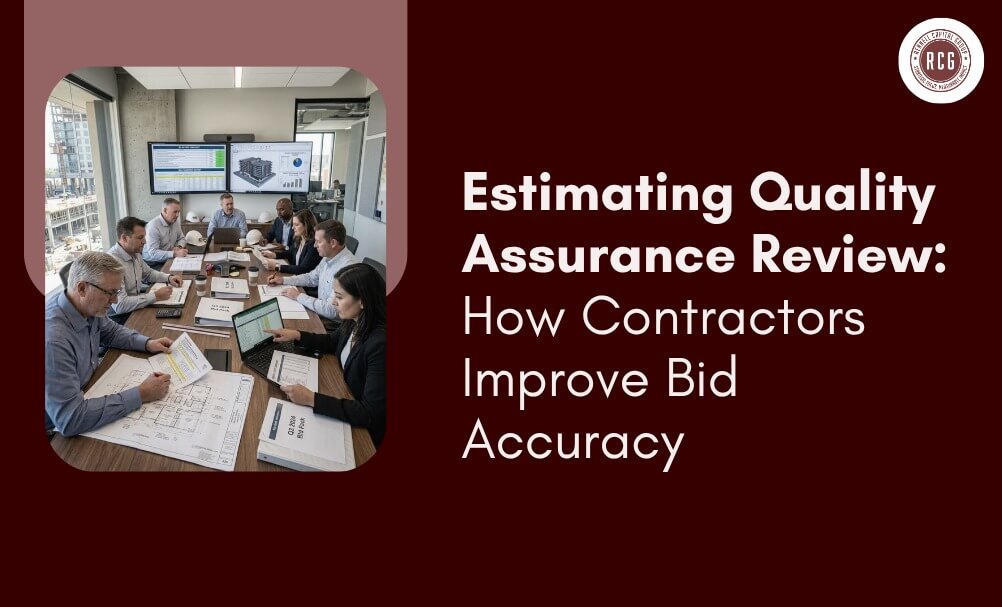
Bid accuracy can make or break a construction project before a single shovel hits the ground. With material and labor costs climbing year after year, even a small error in a cost estimate can wipe out an entire profit margin. That’s where an estimating quality assurance review comes in. This structured process may give contractors a final check on their numbers, helping them catch mistakes before a bid ever reaches the client.
A single missed quantity, an outdated supplier quote, or an overlooked scope item can turn a winning bid into a money-losing job. The stakes are high, and the margin for error is thin.
This guide explains what an estimating quality assurance review involves, why bid accuracy matters so much, and how a structured process helps contractors win more profitable work. You’ll also learn the most common estimating errors, the technology that supports better reviews, and when it makes sense to bring in outside help.
What Is an Estimating Quality Assurance Review?
An estimating quality assurance review is a structured process used to verify the accuracy, completeness, and reliability of a construction estimate before bid submission. It mainly acts as a final quality control check on every number, assumption, and scope item that goes into the bid.
The purpose is simple: catch errors before they become expensive problems. A review confirms that quantities are correct, pricing is current, and nothing has been left out.
This step differs from estimate preparation. Preparation is the work of building the estimate measuring quantities, gathering quotes, and pricing the scope. The review is a separate, independent check of that work. Ideally, someone other than the original estimator performs it, bringing fresh eyes to the numbers.
Contractors perform a pre-bid estimate review for one big reason: there are no second chances once a bid is submitted. A QA review verifies estimate accuracy and completeness while there’s still time to fix problems. It’s the difference between submitting a confident number and gambling on a guess.
Why Bid Accuracy Is Critical in Construction
Construction is a competitive business. On most projects, several contractors bid for the same work, and the winning number often comes down to a narrow gap. An accurate estimate lets you bid aggressively without exposing your business to risk.
Bid accuracy protects profit. When your estimate reflects the true cost of the work, your margin is real. When it doesn’t, you may win the job only to lose money on it. Underbidding can be just as dangerous as overbidding, one costs you the project, the other costs you the profit.
Accurate bids even create budget certainty. Owners and developers rely on your numbers to plan their financing and schedules. A reliable estimate keeps the whole project on solid footing from the start.
There’s also the matter of trust. Contractors who consistently deliver accurate bids earn a reputation for reliability. Clients come back to teams that don’t surprise them with cost overruns.
Consider a simple example. Say an estimator measures 8,000 square feet of a specialty flooring system but the actual area is 10,000 square feet. At $12 per square foot installed, that 2,000-square-foot gap represents a $24,000 shortfall. If the contractor’s margin on the project was only $20,000, that one quantity error turns a profitable job into a loss. Errors like this are exactly what construction cost validation is designed to catch.
The Role of Quality Assurance in Construction Estimating
Quality assurance in estimating isn’t a single action, it’s a system. It has internal review procedures, estimate validation, and clear quality control standards into a repeatable process every estimate goes through.
Internal review procedures set the ground rules. They define who reviews an estimate, what they check, and how they document their findings. A good process leaves nothing to chance or memory.
Estimate validation confirms that the numbers hold up. Reviewers cross-check takeoffs against drawings, compare pricing to current market data, and test assumptions against past project performance. The goal is to confirm that the estimate reflects reality.
Risk reduction is an underlying benefit. Every error caught during a construction estimating review is an error that never reaches the client.
Common Estimating Errors That Affect Bid Accuracy
Most estimating mistakes fall into a handful of recurring categories. Knowing them helps reviewers focus their attention where errors are most likely to hide.
Incorrect Quantity Takeoffs
Quantity takeoff errors are among the most common and costly errors. A misread dimension, a double-counted area, or a missed line item may throw off an entire estimate. As so much of the bid rests on takeoff accuracy, even small mistakes here ripple through the final number.
Missing Scope Items
Sometimes the problem isn’t a wrong number, it’s a number that was never entered at all. Forgotten scope items, such as a fire-stopping detail or a section of underground utilities, leave gaps in the estimate. These omissions even surface during construction, when they become costly you can change orders.
Outdated Material Pricing
Material prices shift quickly. A quote that was accurate three months ago may no longer hold. Using outdated pricing exposes the contractor to escalation risk, especially on projects with long lead times between bid and purchase.
Labor Productivity Miscalculations
Labor is one of the hardest costs to estimate. Overly optimistic productivity assumptions can sink a bid. If a crew can install 100 units a day in theory but only 75 in practice, the labor budget falls short fast.
Incomplete Drawing Reviews
Estimates built on a quick skim of the drawings invite mistakes. Details buried in notes, sections, or specifications get missed. A thorough drawing review during the QA process catches what a rushed first pass overlooked.
Coordination Gaps Between Trades
When multiple trades work on the same project, scope can fall through the cracks between them. Each trade assumes another is handling a particular item, and no one prices it. Coordination checks during the review help close these gaps.
Key Components of an Estimating Quality Assurance Review
A thorough estimating quality control process covers several distinct areas. Each one targets a different source of error, and together they form a complete review.
Scope Verification
Scope verification confirms that the estimate covers everything the project requires, no more, no less. Reviewers go back to the specifications, identify any omissions, and confirm that every project requirement has a corresponding line in estimate.
Quantity Takeoff Validation
A quantity takeoff review involves checking the measurements used to prepare a construction estimate to ensure they match the project drawings. Reviewers verify key quantities such as areas, lengths, and item counts, often using digital takeoff tools for added accuracy.
Material Pricing Review
A material pricing check costs reflect current market conditions. Reviewers check supplier quotes for validity, account for escalation risks on long-lead items, and verify that pricing matches the specified products rather than cheaper substitutes. Now, verified pricing keeps bid grounded in reality.
Labor Cost Evaluation
Labor cost evaluation tests the assumptions behind the people-hours in the estimate. Reviewers examine productivity rates, consider local labor availability, and account for regional cost differences. A labor budget that ignores local conditions is a labor budget that’s likely to fail.
Risk Assessment Review
Estimating risk assessment looks at the bigger picture. Reviewers weigh project complexity, schedule pressures, and design uncertainties that could affect cost. Where risk is high, the estimate should carry appropriate contingency. This step turns hidden uncertainty into a managed, priced factor.
How Contractors Improve Bid Accuracy Through Estimating Quality Assurance Review
The most reliable contractors don’t rely on a single check. They build multiple layers of review into their estimating workflow, so that no single set of eyes is the last line of defense.
Multi-level reviews are a proven approach. A junior estimator’s work gets checked by a peer, then reviewed again by a senior estimator. Each level catches different kinds of errors. Senior estimator oversight is especially valuable, because experience helps spot assumptions that look fine on paper but won’t hold up in the field.
Review checklists keep the process consistent. A standardized bid review checklist ensures every estimate gets the same scrutiny, regardless of who prepares it or how tight the deadline. Checklists also make it easy to document what was reviewed and what was found.
Independent validation adds the final layer of confidence. When someone with no stake in the original estimate reviews it, they bring objectivity that the original estimator can’t.
Technology Supporting Estimating Quality Assurance Reviews
Modern tools have made estimate quality control faster and more reliable. Technology reduces human error and brings consistency to a process that used to rely heavily on manual effort.
- BIM (Building Information Modeling): A coordinated 3D model helps reviewers spot clashes and verify quantities directly from the model, reducing the risk of missed scope.
- Bluebeam: Highly used for digital takeoffs and document markup. Bluebeam lets reviewers check, annotate, and track changes.
- Revit: As a BIM authoring tool, Revit supports model-based quantity extraction and may help confirm which estimates align with the design.
- Digital takeoff software: Purpose-built takeoff platforms speed up quantity verification and make it easy to cross-check measurements.
- Cost databases: Up-to-date cost databases give reviewers a benchmark to compare against, flagging prices that look too high or too low.
Technology doesn’t replace the estimator’s judgment. It supports it.
Benefits of a Structured Estimating QA Process
A disciplined QA process pays for itself many times over. The benefits show up across the entire project lifecycle.
- Fewer change orders: Catching missing scope before the bid means fewer surprises during construction.
- Reduced estimating errors: A repeatable process steadily lessens the rate of costly mistakes.
- Better project profitability: Accurate estimates protect margins and reduce the risk of losing money on a job.
- Improved client confidence: Reliable bids build trust and lead to repeat business.
- Higher bid success rates: Confident, accurate numbers let you bid competitively without overexposing your business.
When Contractors Should Perform an Estimating Quality Assurance Review
A QA review delivers the most value at specific moments. Knowing when to apply it helps you spend your time where it counts.
The most obvious time is before bid submission. Every bid deserves a final check, but some situations call for extra scrutiny. Major design changes are one when the drawings shift significantly, the estimate needs a fresh review to catch new scope and revised quantities.
High-value projects also warrant a thorough review. The larger the contract, the more a single error can cost. Complex MEP projects deserve special attention, since mechanical, electrical, plumbing, and fire protection scopes involve intricate coordination and high material costs.
Why Professional Estimating Consultants Add Value
Sometimes the best review comes from outside the company. Professional estimating consultants bring an independent perspective that internal teams, no matter how skilled, can’t fully replicate.
An outside reviewer has no stake in the original estimate, so they question assumptions freely. They also bring specialized expertise, particularly in complex disciplines like MEP estimating where deep technical knowledge pays off. According to this Associated General Contractors of America (AGC), accuracy and risk management remain central concerns for contractors across the industry.
Consultants can also speed up turnaround when internal teams are stretched thin during busy bid seasons. And because reviewing estimates is their core focus, they’re often quicker to spot the risks that an in-house team, juggling many priorities, might miss. For contractors looking to strengthen their construction bid preparation, an independent review is a smart investment.
Building Profit Into Every Bid
An estimating quality assurance review helps contractors improve the accuracy and reliability of their bids before they are submitted.
The benefits extend beyond a single project. Consistently producing accurate estimates may help contractors manage costs more effectively, avoid unexpected issues during construction, and build stronger relationships with clients. Over time, a reputation for delivering reliable estimates may lead to repeat business and create a meaningful advantage in a competitive market.
Strong quality control practices even contribute to smoother project execution by ensuring that budgets are based on realistic assumptions and complete information from the outset.
At Rennell Capital Group, our team provides MEP estimating, preconstruction consulting, construction management, and cost advisory services to help contractors strengthen their estimating process.
Frequently Asked Questions
What is an estimating quality assurance review?
An estimating quality assurance review is a structured process used to verify the accuracy, completeness, and reliability of a construction estimate before bid submission.
Why is bid accuracy important in construction?
Accurate bids help contractors protect profit margins, reduce project risks, and improve competitiveness during procurement.
What are the most common estimating mistakes?
Common issues include quantity takeoff errors, missing scope items, outdated pricing, and inaccurate labor assumptions.
How can contractors improve estimating accuracy?
Contractors can improve accuracy through quality assurance reviews, standardized checklists, estimate validation, and experienced estimating support.
Should contractors outsource estimating reviews?
Many contractors outsource reviews to gain an independent assessment, reduce risk, and improve bid confidence before submission.

Looking for fresh content?
Get articles and insights from our weekly newsletter.
Recent Posts
Discuss a Project today!