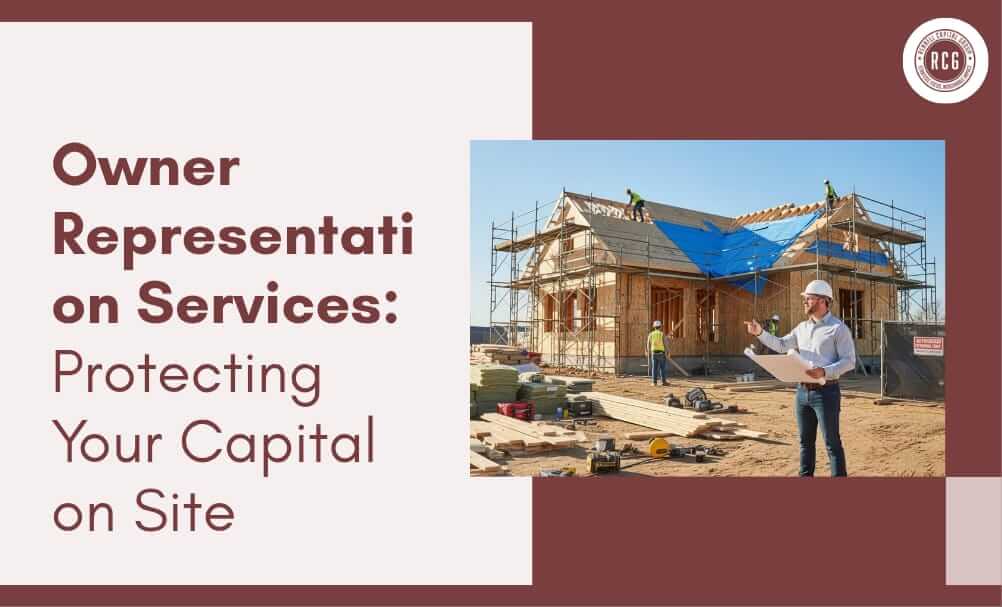
Commercial construction projects are inherently complex and capital-intensive endeavors. Before a single shovel hits the dirt, months or even years of financial modeling, design, and planning have already taken place. However, once ground is broken, capital exposure hits its absolute peak. Without structured oversight, the financial and operational risks associated with a major build increase exponentially.
This is where owner representation services become the ultimate strategic safeguard for property owners and developers. An owner’s representative serves as your dedicated advocate on the job site, ensuring that the project adheres to the established budget, timeline, and quality standards.
In this comprehensive guide, we will explore exactly what these services entail, why your investment capital is so highly vulnerable during the building phase, and the structured frameworks professionals use to mitigate risk. By understanding how to control costs and ensure project success, you can secure your financial interests from the first day of site work to the final handover.
What Are Owner Representation Services?
To put it in practical terms, an owner’s representative acts as an independent oversight authority dedicated entirely to the owner’s goals. This role involves monitoring the daily progress, financial health, and overall trajectory of a construction project.
It is crucial to differentiate this role from that of the General Contractor (GC). The general contractor is hired to manage the physical build, coordinate subcontractors, and ensure the structure goes up according to the blueprints. Naturally, a GC is also operating a business and must protect their own profit margins. The boundaries between the two are clear: the GC manages the physical construction, while the owner’s representative manages the overarching project health on behalf of the investor.
Development oversight consulting exists for one primary objective: to protect the owner’s interests and capital. They are not beholden to the contractor’s bottom line, the architect’s creative vision, or the subcontractors’ schedules. Their sole focus is ensuring the project delivers the expected return on investment without unnecessary capital leakage.
Why Capital Is Most Vulnerable During Construction
The transition from the planning phase to the execution phase represents a massive shift in financial dynamics. Exposure shifts from theoretical projections to actual cash outflows once contracts are signed, materials are ordered, and labor is mobilized. This is the tipping point of capital exposure.
Several key risk factors emerge during this highly vulnerable phase:
- Budget Overruns: Construction is unpredictable. Unforeseen site conditions, material price fluctuations, and labor shortages can rapidly deplete capital if not strictly monitored.
- Unverified Change Orders: Contractors frequently submit change orders when project scopes shift. Without an expert reviewing these requests, owners often pay inflated prices for modifications that should have been included in the original contract.
- Schedule Delays: Time is quite literally money in commercial development. Schedule delays directly impact financing costs, push back tenant move-in dates, and severely damage the overall Return on Investment (ROI).
- Site Miscommunication: Miscommunication between the design team, the GC, and the subcontractors often leads to expensive rework. Tearing down and rebuilding incorrect work drains both time and reserve funds.
Core Functions of Owner Representation Services
An effective owner’s representative provides a comprehensive suite of services designed to keep the project strictly aligned with the owner’s financial and operational goals.
Budget Monitoring & Cost Control
A cornerstone of the representative’s role is meticulous construction budget monitoring. This involves reviewing the contractor’s monthly pay applications to ensure that the billing accurately matches the actual physical progress on the site. If a contractor bills for 50% completion on framing, the rep verifies that half the framing is genuinely finished.
Furthermore, reps track the use of contingency funds to prevent the premature depletion of financial reserves. A major part of cost control in construction is validating and negotiating change orders. Representatives scrutinize the labor rates, material costs, and scope of every change order, rejecting unjustified claims and protecting the budget.
Schedule Oversight
Staying on time requires rigorous methodology. Representatives track specific project milestones against the baseline schedule. This construction project oversight means comparing planned progress with actual site conditions weekly.
If a critical path item begins to slip for example, a delay in structural steel delivery the representative identifies this early. They then work with the contracting team to formulate actionable recovery planning, ensuring minor delays do not snowball into catastrophic timeline failures.
Quality Control
A project that finishes on time but suffers from poor workmanship is not a successful project. Routine, documented site inspections are a necessity. Representatives verify that the materials used and the workmanship executed meet the exact project specifications outlined by the architects and engineers.
These risk prevention strategies catch quality issues early. Identifying a plumbing defect before it is buried behind drywall saves thousands of dollars in destructive remediation later on. According to the Construction Management Association of America (CMAA), proactive quality management significantly reduces the lifecycle costs of commercial facilities.
Contractor Accountability
Enforcing contract compliance is perhaps the most critical daily function of an owner’s rep. They implement a rigorous documentation review process, ensuring that insurance certificates, warranties, and lien waivers are properly submitted and up to date.
By setting up a formal communication structure including mandatory weekly progress meetings and standardized reporting the representative ensures strict contractor accountability. This paper trail minimizes the risk of costly legal disputes at the end of the project.
Common Mistakes Without Owner Representation
Property owners who attempt to manage large-scale construction projects without dedicated representation often fall into several costly traps.
- Blind Reliance: Relying solely on the general contractor’s reporting without independent verification is incredibly risky. A contractor reporting that everything is “on track” may be masking delays to avoid difficult conversations.
- Financial Opacity: A lack of financial transparency can hide deeper project issues. When owners do not demand detailed cost breakdowns, contractors can easily shift funds to cover mistakes, leaving the owner to foot the bill when the budget inevitably runs short.
- Poor Documentation: Inadequate documentation leaves owners completely unprotected during disputes. If a disagreement arises over a schedule delay or a specific material, the party with the most thorough documentation usually wins.
- Reactive Management: Waiting for a problem to occur before addressing it is the most expensive way to build. Proactive project risk management saves capital; reactive problem-solving drains it.
A Structured Oversight Framework
To effectively execute on-site project management and protect capital, an owner’s representative in construction follows a highly structured, step-by-step framework.
- Pre-construction planning review: Before equipment is mobilized, the representative validates the design documents and the project scope, looking for constructability issues or missing details.
- Budget validation: The initial budget numbers are analyzed to ensure they are realistic, comprehensive, and accurately reflect current market conditions.
- Contract alignment: The representative reviews the general contractor’s agreement, ensuring that the contract language heavily protects the owner from undue liability and unfair payment terms.
- Ongoing site reporting: Establishing a strict cadence for transparent, objective progress updates. This keeps the owner informed without requiring them to visit the site daily.
- Risk flagging: Implementing an early warning system for any schedule or cost deviations. If a risk is identified, the owner is alerted immediately alongside a proposed mitigation strategy.
- Final cost reconciliation: During project closeout, the representative ensures that all final billing is financially accurate, all punch-list items are completed, and all warranties and manuals are handed over before the final payment is released. For more on optimizing internal financial strategies during this phase, consider reviewing our guide on Capital Advisory Strategies.
How Owner Representation Supports Long-Term Capital Strategy
The benefits of hiring an owner’s rep extend far beyond the day the certificate of occupancy is issued. The physical construction is intimately tied to the overall financial performance of the asset.
Capital Preservation
The most immediate benefit is capital preservation. Connecting rigorous on-site oversight directly to the protection of the overarching investment ensures that development funds are spent efficiently. Every dollar saved on site is a dollar that improves the final capitalization rate of the property.
Investor Confidence
Having a professional owner’s representative in construction severely reduces anxiety for financial stakeholders. It reassures lenders, corporate boards, and equity partners that an independent expert is watching their money. This level of professional oversight can often make it easier to secure favorable financing terms.
Reduced Volatility
Construction is notorious for financial shocks. Capital protection strategies enacted by an owner’s rep mitigate these surprises. By carefully managing contingency funds and anticipating supply chain disruptions, the representative smooths out the financial volatility typically associated with building.
Sustainable Execution
Effective representation bridges the gap between physical construction management and high-level capital advisory. It shows how executing a project properly ensures long-term asset profitability. A well-built building requires less maintenance, attracts better tenants, and holds its value longer.
Let’s Wrap This Up
Construction is where planning meets execution, and where capital exposure becomes most tangible. Without structured oversight, even well-planned projects can encounter avoidable financial and operational challenges.
Owner representation services provide an independent layer of accountability, ensuring budgets are monitored, schedules are maintained, and contractor performance aligns with project objectives. This disciplined approach protects capital while supporting clear communication and proactive risk management.
At Rennell Capital Group, our Capital Advisory team integrates financial strategy with on-site oversight to help property owners and developers navigate construction with clarity and structure. By aligning capital planning with execution management, we help ensure projects move forward with transparency and control.
For expert support on your next project, explore Rennell Capital Group’s MEP estimating and construction consulting services to ensure your costs are accurate and your budget is protected from the start.
When capital is protected on site, long-term objectives remain intact.