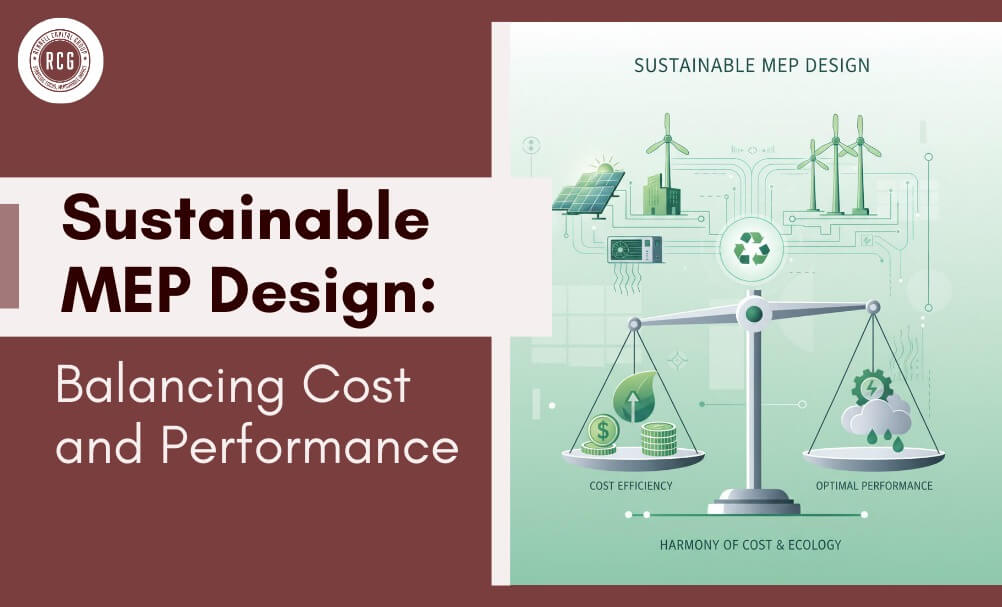
Sustainability is no longer seen as an added benefit in commercial construction; it has become something people expect as a standard. Regulations are getting stricter, tenants are paying more attention to energy-efficient spaces, and investors are looking closely at how buildings perform from an environmental point of view. For developers and contractors, this shift means that building sustainably is not just about responsibility anymore; it directly affects competitiveness and long-term value.
A big part of this change comes down to MEP systems, mechanical, electrical, and plumbing. These systems are responsible for a large share of how a building operates every day, especially when it comes to energy use. In fact, they often account for nearly half, or even more, of a building’s total energy consumption. Because of this, the way these systems are designed has a major impact on how efficient a building will be over time. When done well, it can lead to lower operating costs and better performance for many years. When done poorly, it can result in ongoing inefficiencies that are expensive to fix later.
One of the main concerns for developers is the higher upfront cost that often comes with sustainable solutions. It’s natural to question whether spending more at the beginning makes sense. In most cases, it does; but only if the decisions are made thoughtfully during the early planning stages. Long-term savings and performance benefits usually outweigh the initial investment when the design is done right.
This guide explains what sustainable MEP design involves, why it matters from both a financial and operational perspective, the approaches that deliver real results, and the practical challenges teams often face while implementing them.
What Is Sustainable MEP Design?
Sustainable MEP design focuses on optimizing mechanical, electrical, and plumbing systems to reduce energy consumption, lower operating costs, and improve building performance throughout the lifecycle of a project.
Each of the three components carries a distinct sustainability role:
- Mechanical systems govern heating, ventilation, and air conditioning (HVAC). They regulate indoor temperature, air quality, and humidity and in most commercial buildings, they represent the single largest energy load.
- Electrical systems cover lighting, power distribution, and building automation. Smart, efficient electrical design reduces grid dependency and delivers measurable savings on energy bills.
- Plumbing systems manage water supply, drainage, and hot water delivery. Efficient plumbing design cuts both direct water costs and the indirect energy cost of heating water.
Think of MEP systems as the circulatory system of a building. When they’re inefficient, the whole building pays the price higher utility bills, increased maintenance demand, shorter equipment lifespan, and worse occupant experience. Green building MEP design principles, once considered niche, are now embedded in mainstream construction standards globally.
Why Sustainable MEP Design Matters
Lower energy use
Well-designed building systems can significantly reduce how much energy a building consumes. In many cases, energy usage can drop by 30–50% compared to traditional construction methods. This kind of reduction has a direct impact on both costs and overall efficiency.
Reduced operating costs
When a building uses less energy, monthly utility bills go down. Over time, these savings add up. For buildings designed to last decades, the money saved on energy can easily cover the higher upfront cost of efficient systems, and often much more.
Better comfort for occupants
Energy-efficient HVAC and lighting systems improve indoor conditions. They help maintain consistent temperatures, improve air quality, and provide better lighting. These factors can make a noticeable difference in how comfortable people feel and how well they perform in the space.
Lower environmental impact
Using less energy also means reducing emissions and conserving resources. As governments continue to tighten environmental regulations, buildings that are designed with efficiency in mind are better prepared to meet these standards.
Stronger property value
Buildings that perform well in terms of sustainability are often more attractive to tenants and investors. They tend to command higher rental values, experience fewer vacancies, and hold their value better over time.
Similarly, ASHRAE provides widely used guidelines, including standards such as ASHRAE 90.1, which forms the basis for many building energy codes.
Key Strategies for Sustainable MEP Design
High-Efficiency HVAC Systems
HVAC is typically the dominant energy consumer in commercial buildings, which makes it the most important target for sustainable design. Several technologies have proven their value across a wide range of project types.
Variable refrigerant flow (VRF) systems offer zoned temperature control, allowing different areas of a building to be conditioned independently based on occupancy and use. Compared to conventional systems, VRF systems can deliver significant energy savings while improving individual comfort.
High-efficiency chillers have advanced considerably. Modern units routinely achieve coefficient of performance (COP) ratings well above industry averages, when paired with variable speed drives and intelligent controls.
Demand-controlled ventilation (DCV) adjusts airflow based on actual occupancy, eliminating the energy waste of ventilating empty or underoccupied spaces at full capacity.
ASHRAE’s Guideline 36-2024 gives high-performance sequences of operation for HVAC systems, that offers a standardized framework for maximizing energy efficiency, ensuring control stability, and enabling real-time fault diagnostics.
Sustainable HVAC systems designed to these standards don’t just reduce energy bills; they form the foundation of a building’s entire performance profile.
Energy-Efficient Electrical Systems
Electrical systems account for a substantial share of a building’s energy profile, particularly in office and retail environments where lighting and equipment loads are high.
LED lighting is now the standard for efficient commercial design, consuming a fraction of the energy of older fluorescent systems while lasting significantly longer. The operational lifespan advantage alone often justifies the upfront investment.
Smart lighting controls including occupancy sensors, daylight harvesting systems, and programmable dimming, eliminate the hidden waste of lights left running in empty spaces. In large commercial buildings, these savings add up quickly.
Building automation systems (BAS) tie it all together. Centralized control platforms monitor and optimize electrical systems in real time, identifying inefficiencies and enabling data-driven decisions about energy use. The connection between energy-efficient mechanical systems and reduced grid dependency becomes most visible at the BAS level, where the entire building’s performance can be tracked and tuned continuously.
Water Efficiency in Plumbing Systems
Plumbing’s sustainability impact is twofold: direct water consumption and the energy required to heat water. Efficient plumbing design addresses both.
Low-flow fixtures; faucets, toilets, and showerheads engineered to reduce consumption without sacrificing usability can cut a building’s water use by 30–50% over standard fixtures. The technology has matured considerably; performance is rarely compromised.
Water recycling systems, including greywater reuse and rainwater harvesting, reduce dependency on municipal water supply. These systems are increasingly viable even in urban environments and contribute directly to LEED certification points.
Efficient piping design minimizes pipe lengths and uses high-quality insulation to reduce heat loss while distribution. Shorter runs mean less pumping energy; better insulation means less energy wasted heating water.
Water efficiency is a core element of building energy efficiency planning and, when properly executed, contributes meaningfully to both cost savings and certification outcomes.
Balancing Initial Cost vs. Lifecycle Performance
One of the most common concerns about sustainable MEP systems is the higher upfront cost. That concern is valid in many cases, but it doesn’t tell the full story. The real question is not just what you pay at the beginning, but what the system will cost over its entire lifespan.
LCA looks at the complete cost of a system from start to finish. It includes the purchase price, installation, energy use, maintenance, and eventual replacement. When all of these factors are considered together, the results often challenge the idea that the cheapest option upfront is the most economical choice.
Take a simple example. A high-efficiency chiller might cost 20–30% more than a standard unit at the time of purchase. However, if it reduces energy use by around 25% each year, those savings can recover the extra cost within five to seven years. On top of that, efficient systems often require less maintenance and tend to last longer, which further improves their overall value.
Another important point is timing. Decisions made early in the design stage have a much bigger impact than changes made later. Trying to upgrade an HVAC system after installation can cost two or even three times more than selecting the right system from the beginning. It also delays the benefits that could have been achieved earlier.
When viewed over the long term, higher-performing MEP systems often prove to be the more cost-effective choice, even if the initial investment is higher.
| Timeframe | Standard Systems | High-Performance Systems |
|---|---|---|
| Year 1 | Lower upfront cost | Higher upfront cost |
| Years 1–7 | Higher operating costs | Recovering cost premium through energy savings |
| Years 10–20 | Costs compounding; possible early replacement | Continued savings; lower maintenance burden |
| Years 20–30 | Significant lifecycle cost disadvantage | Clear lifecycle cost advantage |
The math is not complicated. What’s required is the willingness to evaluate cost over time rather than at the point of purchase.
The Role of MEP Planning in Sustainable Construction
Sustainable outcomes are largely determined before construction begins. The planning and preconstruction phase is where the most impactful decisions are made, and where the most value can be captured or lost.
Early MEP coordination delivers measurable benefits across several dimensions:
- Reduced material waste through accurate quantity takeoffs and right-sized system specifications. Over-engineered systems waste both materials and energy.
- Fewer costly clashes between mechanical, electrical, and structural components. Coordination conflicts resolved on paper cost a fraction of what they cost to fix on site.
- Better integration of high-performance building systems from day one. Sustainable design works best when it’s built into the project logic, not added as an afterthought.
Identifying sustainable design opportunities early, and stress-testing them against realistic cost targets before commitments are made, is how experienced teams ensure that sustainability goals survive contact with budget constraints. Our MEP estimating services and construction cost planning processes are specifically structured to support this kind of early-stage decision-making.
Common Challenges in Sustainable MEP Design
Sustainable MEP design is not without its difficulties. Teams who understand the challenges upfront are better positioned to navigate them effectively.
Higher upfront investment. Budget constraints remain the most persistent barrier. When procurement decisions are made on first cost alone, cheaper but less efficient systems win, and the building pays the price for decades.
Coordination complexity. Integrating multiple sustainable systems; HVAC, smart electrical, water recycling, and automation; requires tight collaboration across disciplines. Without structured coordination processes, conflicts multiply and cost savings erode.
Technology integration. Smart systems and building automation platforms must be compatible with existing infrastructure and interoperable with each other. Poorly integrated systems fail to deliver their promised performance. Experienced MEP consultants identify these risks early, during the feasibility study phase, before they become construction problems.
Evolving energy codes. Regulations continue to tighten. ASHRAE 90.1 updates regularly raise the bar for energy performance, and keeping pace with these changes adds planning complexity. Teams working with specialized consultants are better positioned to stay ahead of compliance requirements rather than scrambling to meet them after design has progressed.
Each of these challenges is manageable with the right expertise. The teams that struggle are those that treat MEP sustainability as a specification task rather than a planning discipline.
Future Trends in Sustainable Building Systems
The direction of travel in green building MEP design is clear, and moving fast.
Smart buildings powered by AI are transitioning from pilot projects to mainstream construction. Systems that learn occupancy patterns, self-optimize energy use, and predict maintenance needs are becoming standard features in high-performance commercial buildings.
Renewable energy integration is accelerating. On-site solar, wind, and geothermal systems are increasingly being paired with MEP infrastructure from the design phase, enabling buildings to generate a meaningful share of their own energy.
Advanced energy monitoring through sub-metering and real-time dashboards gives facility managers granular visibility into where energy is being used, enabling continuous performance improvement rather than periodic reviews.
Net-zero buildings, where the energy produced on site equals the energy consumed are no longer aspirational targets reserved for flagship projects. Regulatory frameworks and improving technology are making them achievable across a broader range of building types and budgets.
ASHRAE’s ongoing work on refrigerant lifecycle management and building decarbonization signals where industry standards are heading. Their recently approved two-year work plan with UNEP focused on life cycle refrigerant management is one example of the technical groundwork being laid for the next generation of sustainable MEP systems.
For developers planning projects today, designing with these trends in mind is not premature; it’s prudent. Retrofitting for net-zero capability in a building designed to 2015 standards costs significantly more than building that capability in from the start.
Final Thoughts
Buildings designed with efficiency in mind from day one outperform those that aren’t on energy costs, maintenance burden, occupant satisfaction, and long-term asset value. The environmental case for sustainable MEP design is compelling. The financial case is stronger still.
Achieving these outcomes, however, requires more than specifying efficient equipment. It demands deep technical expertise, disciplined cost planning, and early-stage collaboration between MEP engineers, cost consultants, and design teams. The gap between sustainable design intent and sustainable construction outcomes almost always traces back to planning decisions made or missed; before construction began.
At Rennell Capital Group, our specialists provide expert MEP estimating, cost planning, and preconstruction consulting services to help developers and contractors deliver efficient building systems without exceeding budgets. We work alongside your team from the earliest stages of a project to identify opportunities, stress-test assumptions, and ensure that sustainability goals translate into real performance outcomes.
Contact Rennell Capital Group today to learn how our expertise can support smarter, more sustainable construction projects.
Frequently Asked Questions
What is sustainable MEP design?
Sustainable MEP design is the practice of optimizing mechanical, electrical, and plumbing systems to minimize energy consumption, reduce operating costs, and maximize building performance across its entire lifecycle. It combines technical efficiency with strategic planning to deliver buildings that perform better and cost less to run.
How do MEP systems affect building sustainability?
MEP systems account for 40–60% of a commercial building’s total energy consumption. The efficiency of these systems directly determines utility costs, carbon output, occupant comfort, and long-term operating performance. Poor MEP design creates inefficiencies that compound over decades; optimized MEP design generates savings that do the same.
What are the benefits of energy-efficient HVAC systems?
Sustainable HVAC systems reduce energy consumption (often by 25–40% compared to standard systems), lower utility costs, improve indoor air quality and occupant comfort, and contribute to LEED certification credits. Over a building’s lifecycle, the operational savings consistently exceed the upfront cost premium.
How does lifecycle cost analysis apply to MEP design?
Lifecycle cost analysis evaluates the total cost of a system over its operational life; not just its purchase price. Applied to MEP design, it accounts for energy consumption, maintenance, replacement cycles, and operational performance. It routinely shows that higher-efficiency systems cost less over time, which changes how procurement decisions should be made.
What certifications are relevant to sustainable MEP design?
To learn how expert guidance can protect your investment, explore Rennell Capital Group’s capital advisory services designed to help developers and owners make confident, data-driven decisions at every stage of a project.
LEED certification is the most widely recognized framework, with specific credits tied to energy performance, water efficiency, and indoor environmental quality, all directly influenced by MEP design. ASHRAE standards, including ASHRAE 90.1 (energy standard for buildings) and Guideline 36-2024 (HVAC sequences of operation), provide the technical benchmarks that underpin both certification and code compliance.