

MEP systems, mechanical, electrical, and plumbing are what keep a commercial building running day to day. They handle everything from heating and cooling to power supply and water flow. They also make up one of the largest portions of a project’s cost. On many commercial builds, MEP work can represent 40–60% of the total construction budget, which is why getting the numbers right from the start is so important.
A detailed MEP quantity takeoff is the first step toward building an accurate cost estimate. When it’s done properly, it supports better budgeting, smoother procurement, and more reliable bids. When it’s not, the impact can be felt throughout the entire project.
An MEP quantity takeoff is the process of going through project drawings and identifying every material needed for the mechanical, electrical, and plumbing systems. This includes measuring, counting, and listing all components, from pipes and ducts to wiring and fixtures. The goal is to create a clear and complete record of what will be required so costs can be calculated with confidence and materials can be planned in advance.
This guide walks through the key aspects of MEP quantity takeoffs in a practical way. It explains what they are, why they matter, and what goes into them. It also breaks down the process step by step, highlights common mistakes to watch out for, and looks at the tools professionals use. Most importantly, it shows how accurate takeoffs help teams make better decisions early, long before construction begins.
What Is an MEP Quantity Takeoff?
An MEP quantity takeoff is the process of measuring and listing all mechanical, electrical, and plumbing materials required for a construction project. It sits at the very beginning of the construction estimating process, before procurement, before bidding, and before scheduling. Without it, cost estimates are little more than educated guesses.
It’s also important to distinguish between a quantity takeoff and a cost estimate, because the two are often confused. A takeoff produces material quantities; lengths of pipe, counts of fixtures, linear footage of conduit. A cost estimate takes those quantities and assigns dollar values using unit pricing and labor rates. One cannot exist without the other, but they are distinct activities.
In MEP estimating, the takeoff is the foundation. Every decision made downstream, how much to bid, what to order, when to schedule deliveries, flows from the accuracy of that initial material count.
Why MEP Quantity Takeoffs Matter in Construction
Skipping or rushing through an MEP quantity takeoff doesn’t save time. It creates problems that are far more expensive to solve later.
Accurate project budgeting. Without a detailed takeoff, cost estimates rely on approximations that leave significant gaps in a project budget. Gaps in estimates become gaps in funding, and gaps in funding become project delays.
Preventing material shortages. Precise material lists ensure procurement teams order the right quantities. Running short on a critical component mid-construction can halt an entire trade, triggering expensive delays that affect every subsequent schedule.
Supporting competitive bidding. Contractors who base their bids on detailed MEP takeoffs are better positioned to win work while still protecting their margins. Vague estimates either leave money on the table or put a contractor at risk of absorbing losses.
Improving project planning. Takeoffs surface long-lead items custom HVAC units, specialty switchgear, large-diameter piping, that need to be ordered weeks or months in advance. Identifying these early prevents the kind of last-minute scrambling that disrupts construction schedules.
Reducing financial risk. A detailed takeoff helps project teams catch potential cost issues early, before construction even starts. When quantities are clearly measured and documented, it becomes easier to see where costs might run higher than expected. This gives the team a chance to make adjustments while there is still time to do so without major disruption. Industry bodies such as ASHRAE highlight the importance of clear and thorough documentation.
Key Components of an MEP Quantity Takeoff
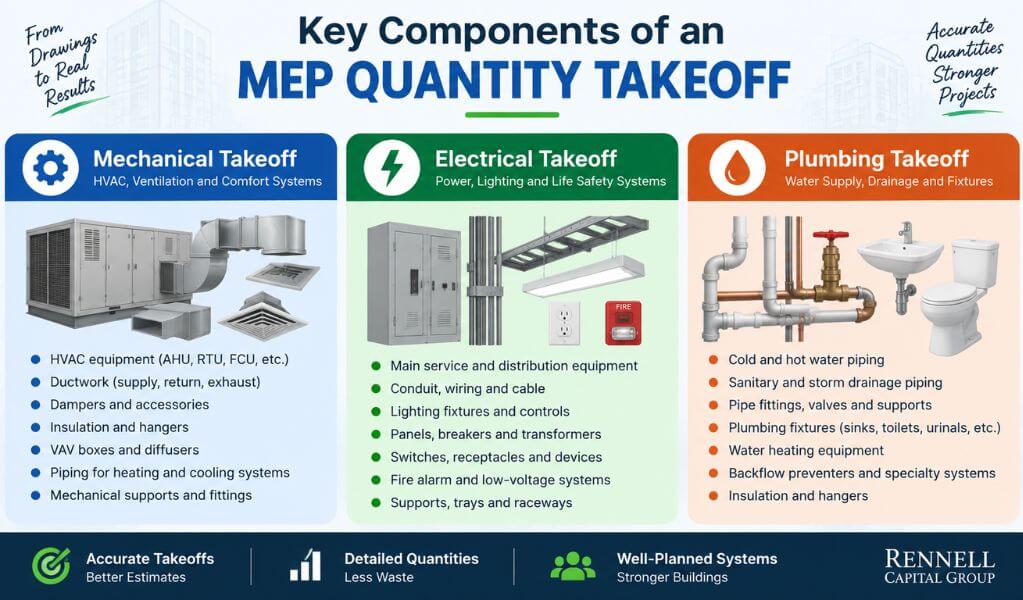
Mechanical Takeoff
The mechanical quantity takeoff covers all HVAC-related materials. This includes major equipment such as air handling units, chillers, boilers, and fan coil units, as well as the distribution system: ductwork (supply, return, and exhaust, measured in linear feet or square footage), insulation for both ductwork and piping, and ventilation components like diffusers, grilles, and dampers.
Mechanical systems are typically the most complex to take off. Custom equipment sizing, intricate ductwork routing, and significant variation between projects make mechanical takeoffs time-intensive and detail-dependent. A small error in ductwork measurement, for example, can cascade into significant material overages or shortages across an entire floor.
Electrical Takeoff
An electrical takeoff focuses on identifying and measuring all the materials needed for a building’s power and lighting systems. This includes different types of conduit such as EMT, rigid, and flexible, usually measured in linear feet. It also covers wiring and cables, which may be measured by length or by circuit, along with electrical panels, switchgear, lighting fixtures, outlets, and switches.
Getting these quantities right depends on a clear understanding of the electrical drawings. In particular, single-line diagrams and panel schedules play a major role. They show how power is distributed throughout the building and how different systems are connected. These mistakes often go unnoticed until installation begins, making them harder and more expensive to fix later.
Plumbing Takeoff
Plumbing takeoff estimation includes both domestic water systems and sanitary systems, and each needs to be handled separately because they use different materials and follow different requirements. The process involves identifying and measuring all the components needed, such as supply pipes, waste lines, and vent pipes, which are usually measured in linear feet and categorized by size or diameter. Drainage elements, including floor drains, are also part of the takeoff.
One area that often gets underestimated is the number of fittings required. It’s easy to focus more on pipe lengths and overlook how many connectors are needed to complete the system. In reality, fittings can make up a significant portion of the cost, sometimes adding 20–30% to the total expense of a pipe run. Due to this, they need to be carefully counted and included from the beginning rather than treated as a minor detail.
Step-by-Step Process for MEP Quantity Takeoff
Step 1: Understand the Drawings First
Start by carefully reviewing all MEP drawings along with the architectural plans and project specifications. Take your time here rather than jumping straight into measurements. Pay attention to how different systems connect and overlap, since a layout that looks fine in one drawing may clash with another. Always check that you’re using the latest revision of the drawings. Also remember, not everything is shown visually; important details about materials and installation are often written in the specifications.
Step 2: Break the Systems Into Sections
Once you have a clear understanding of the drawings, divide each system into smaller sections. Use the legend and symbol guide to correctly identify every component. MEP drawings can be detailed and sometimes confusing, so working in an organized way makes things much easier. Creating a simple checklist for each system helps ensure you don’t miss anything before you begin measuring.
Step 3: Measure and Count with Care
After organizing the systems, begin measuring quantities. Linear elements such as pipes, conduits, ductwork, and wiring should be measured by length. Fixtures, equipment, and fittings need to be counted individually. It’s also a good idea to include a small allowance for waste, usually around 5–10%, since some material is always lost during cutting and installation.
Step 4: Keep Your Data Organized
As you collect an information, record it in a neat and structured format. Group similar items by system and type so everything is easy to review later.
Step 5: Apply Costs and Review Everything
Finally, assign costs using up-to-date pricing or supplier quotes. Add labor costs, local rates, and any site-specific conditions that may affect the work. Before wrapping up, review the entire takeoff and compare it with past estimates to catch any unusual numbers.
Also Read: Understanding the MEP Estimation Workflow in Preconstruction
Common Mistakes in MEP Quantity Takeoffs
Even experienced estimators run into trouble. These are the most frequent mistakes in MEP cost estimating and how each one causes real financial damage.
Missing components. Fittings, supports, hangers, and accessories are easy to overlook, particularly on large projects. As noted above, fittings alone can add 20–30% to a pipe run’s cost. Missing them consistently produces estimates that look competitive but are guaranteed to lose money.
Incorrect measurements. Scaling errors on digital or paper drawings lead to systematic under- or over-estimating across entire systems. A 10% scaling error multiplied across thousands of linear feet of conduit represents a significant budget variance.
Using outdated pricing. Material costs particularly copper piping and electrical wire fluctuate significantly. Applying pricing from a project completed two years ago to a project bidding today is a reliable path to cost overruns.
Ignoring site conditions. Difficult site access, confined spaces, or complex routing paths all increase labor hours and affect material quantities. An estimate that doesn’t reflect site realities isn’t accurate; it’s optimistic.
Failing to coordinate between trades. MEP systems compete for the same ceiling and wall space. Takeoffs that don’t account for coordination conflicts may require costly redesigns or rerouting during construction, affecting both materials and labor.
Tools Used for MEP Quantity Takeoffs
The right tools don’t just speed up the takeoff process—they reduce errors and produce more defensible numbers.
| Tool | Primary Use |
|---|---|
| Bluebeam Revu / PlanSwift | Measure directly from digital drawings; reduce manual measurement errors |
| Trimble Accubid | Trade-specific MEP estimating and quantity tracking |
| RSMeans / Gordian | Up-to-date unit cost data for materials and labor across all MEP trades |
| Autodesk Revit (BIM) | Auto-generate quantity reports directly from 3D models for complex projects |
| Scale rules / planimeters | Manual measurement tools for projects still using paper drawings |
BIM-based takeoffs using Autodesk Revit represent the most significant advancement in building systems estimating. When models are built to the right level of detail, quantity reports can be generated directly from the 3D model dramatically improving accuracy and reducing the time required to produce a complete material list. For projects where BIM is available, leveraging it for takeoff purposes is increasingly standard practice on large commercial work.
The Role of MEP Takeoffs in Preconstruction Planning
The preconstruction phase is where the most impactful cost decisions in a construction project are made. MEP quantity takeoffs sit at the center of that phase.
Cost estimating. Takeoffs are the direct input into MEP cost estimates. Without precise material quantities, budget figures lack credibility and lenders, owners, and developers rely on those figures to make go/no-go decisions.
Procurement planning. Detailed material lists give procurement teams what they need to solicit supplier quotes early, lock in pricing, and identify long-lead items before they create schedule risks. On complex commercial projects, some mechanical equipment has lead times of 20–40 weeks. Catching that early in preconstruction is the difference between a smooth construction schedule and a delayed project.
Scheduling. Knowing material quantities and delivery lead times helps schedulers sequence MEP installations correctly and prevent idle trades from waiting on materials that haven’t arrived yet.
Risk management. Early identification of complex or expensive system components opens the door to value engineering exploring alternative materials, different routing strategies, or prefabrication opportunities before any concrete has been poured. MEP takeoff services performed during preconstruction are among the highest-return investments a project team can make.
Frequently Asked Questions
What is an MEP quantity takeoff?
An MEP quantity takeoff is a detailed list of the mechanical, electrical, and plumbing materials needed for a construction project. It includes items such as pipes, ducts, wires, fixtures, and equipment. Accurate quantities help estimators calculate project costs and plan material purchases.
How accurate should a quantity takeoff be?
The accuracy of a quantity takeoff depends on the quality and detail of the project drawings. Early design drawings may provide rough quantities. As the design becomes more detailed, the takeoff can become more accurate. A careful review also helps reduce missing or incorrect quantities.
What tools are used for MEP takeoffs?
MEP estimators often use digital tools such as PlanSwift and Bluebeam Revu to measure quantities from drawings. They may also use RSMeans or Gordian for cost information and Autodesk Revit for BIM-based projects. The right tool depends on the project and available drawings.
Who performs an MEP quantity takeoff?
MEP quantity takeoffs are usually completed by experienced construction estimators. These professionals understand mechanical, electrical, and plumbing systems and know how to read construction drawings. Contractors may use their own estimating team or hire a professional MEP estimating company.
What is the difference between an MEP takeoff and an MEP estimate?
An MEP takeoff tells you how much material is needed for the project. An MEP estimate tells you how much the work may cost. The estimator first calculates the quantities and then adds material prices, labor costs, equipment costs, and other expenses to prepare the estimate.
Final Thoughts
An MEP quantity takeoff isn’t just a line item in the preconstruction workflow it’s the financial backbone of a construction project. Every budget figure, every procurement order, every scheduling decision for mechanical, electrical, and plumbing systems traces back to the accuracy of that initial material count. Errors in MEP estimating, whether from missing components, outdated pricing, or poor measurement, don’t stay on the takeoff sheet. They show up as cost overruns, schedule delays, and difficult conversations with clients during construction.
It’s a specialized discipline and the difference between a reliable estimate and an optimistic one often comes down to who performs it.
Rennell Capital Group’s MEP estimating specialists work with developers, contractors, and owners to ensure every system is fully accounted for and every dollar is properly justified. From mechanical quantity takeoffs to full building systems estimating, the team provides the precision and expertise that preconstruction decisions demand.
If you’re looking for expert support on your next project, Rennell Capital Group offers both MEP estimating and construction consulting services and capital advisory solutions to help you plan smarter, reduce risk, and protect your investment from the ground up.
Contact Rennell Capital Group today to learn how our MEP estimating expertise can strengthen the financial foundation of your next project.