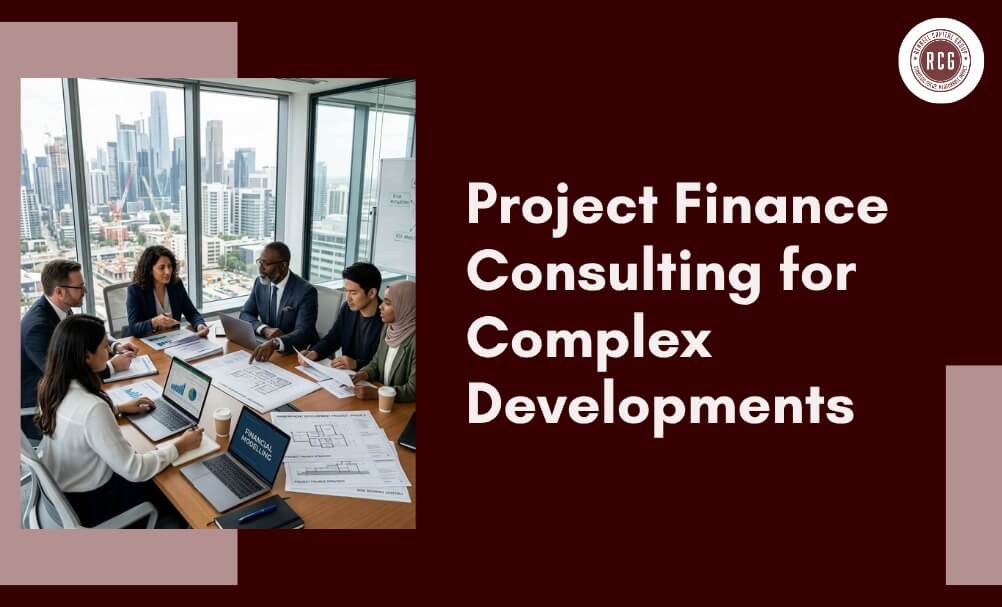
Managing the finances of a large real estate development involves much more than securing funding at the start. Throughout project, developers must search changing market conditions, construction timelines, fluctuating costs, and other factors that can influence financial performance.
Weak financial planning may create serious challenges as a project moves forward. When budgets do not accurately reflect real costs, unexpected expenses may place significant pressure on available funds. This may lead to cash flow problems, project delays, strained relationships with contractors, and concerns from investors.
This is where project finance consulting becomes a strategic solution. Consultants step in to align complex capital requirements with real-world execution timelines.
What Is Project Finance Consulting?
Project finance consulting may help developers and investors plan, organize, and manage funding needed for huge projects. It has considering financial needs, evaluating funding options, and creating a structured plan that supports the project from start to completion. The goal is to ensure that financial resources are available at the right stages of the project while helping teams make informed decisions about budgeting, financing, and overall project execution.
This discipline is different from standard financing. Financing simply provides the capital. Financial consulting provides the strategy to manage that capital effectively. Lenders and investors supply the money, but project finance consulting dictates how those funds are deployed, monitored, and protected via lifecycle of the build.
Large and complex projects even need a well-organized financial plan due to the scale of investment involved. Careful coordination of funding is essential to ensure that resources are available when varied phases of the project begin.
Why Complex Developments Require Specialized Financial Planning
Building a high-rise, a mixed-use commercial center, or a master-planned community involves variables that simple projects never encounter. These large developments demand specialized financial planning for several critical reasons.
Multiple Funding Sources
Major real estate developments often bring together several sources of funding, each playing a different role in the project. With multiple lenders, investors, and financial partners involved, keeping everything organized can become a challenge.
Long Construction Timelines
Large development projects often take several years to complete, and a lot can change during that time. Construction costs may increase, financing conditions can shift, and market trends may evolve. Because of this, long-term financial planning is essential.
Higher Capital Exposure
The sheer volume of money involved in complex development financing means that the financial exposure is massive. A five percent cost overrun on a small residential build is manageable. A five percent overrun on a $500 million commercial center can wipe out profit margins and trigger loan defaults. Advanced capital structuring for developments protects the project from these catastrophic financial shocks.
Increased Operational Risk
Large sites have more moving parts. You have more contractors, more regulatory hurdles, and more environmental variables. Each of these operational risks carries a financial consequence. Strong financial planning for developers anticipates these risks and builds contingency reserves into the budget to absorb unexpected costs.
Key Components of Project Finance Consulting
A comprehensive financial strategy relies on several foundational pillars. Project finance consulting breaks the process down into manageable, strategic components.
Capital Structure Planning
This involves determining the exact mix of debt and equity needed to fund the project. Consultants analyze the cost of capital from various sources and design a structure that maximizes returns while minimizing financial strain.
Development Budgeting
Accurate budgeting goes far beyond estimating construction costs. It includes soft costs, financing fees, interest reserves, and operating expenses. A robust budget leaves no hidden costs unaccounted for.
Cash Flow Forecasting
Timing is everything in real estate project financing. Cash flow forecasting maps out exactly when capital will be drawn down and when expenses must be paid. This prevents the project from experiencing sudden liquidity crises.
Risk Assessment and Mitigation
A key part of financial planning is knowing potential risks before they become serious problems. By reviewing different scenarios, such as project delays, rising borrowing costs, or unexpected increases in expenses, project teams can better understand how these challenges might affect the budget.
Funding Timeline Coordination
Lenders release funds in stages based on construction progress. Project finance consulting ensures that these funding releases are perfectly synchronized with contractor payment schedules to keep the site operational.
Common Financial Challenges in Complex Developments
Even with the best intentions, developers frequently encounter severe financial roadblocks if they lack a dedicated project funding management strategy.
Cost overruns are incredibly common. Changes in scope, design errors, or unexpected site conditions can quickly inflate the budget. Without adequate contingency planning, developers are forced to seek expensive rescue capital.
Delayed funding releases present another major hurdle. If a lender withholds a draw because a milestone was missed, contractors do not get paid. This leads to work stoppages and further delays.
Cash flow shortages often occur when developers miscalculate the timing of their expenses. Money might be committed to the project, but if it is not liquid when a bill is due, the project stalls. Misaligned financing structures—such as using short-term debt for a long-term asset—can also cripple a development, forcing refinancing under unfavorable terms.
How to Build a Strong Financial Strategy for Large Developments
Success in real estate requires a systematic approach. Here is how project finance consulting builds a resilient financial framework.
Step 1: Define Project Scope and Objectives
Clarity is the first requirement. Developers must clearly define the final product, the target market, and the expected timeline. This scope dictates all subsequent financial modeling.
Step 2: Estimate Total Development Costs
Calculate every conceivable cost. This includes land acquisition, hard construction costs, architectural fees, legal expenses, and financing costs. Accuracy at this stage dictates the reliability of the entire capital plan.
Step 3: Identify Funding Sources
Determine which lenders and investors are the best fit for the project’s risk profile. Evaluate the terms, rates, and covenants associated with different capital providers to find the most efficient mix.
Step 4: Structure the Capital Stack
Layer the funding sources strategically. Decide how much senior debt, mezzanine debt, and equity will be used. The goal is to balance the cost of capital with the desired return on investment.
Step 5: Create Cash Flow Forecasts
Map out the inflow and outflow of cash on a monthly basis for the duration of the project. Ensure there is always a buffer to cover unexpected expenses between funding draws.
Step 6: Monitor Financial Performance During Construction
A financial strategy is a living document. Real estate financial consulting requires ongoing monitoring. Compare actual costs against the budget constantly, adjusting the forecast as real-world conditions evolve.
The Relationship Between Project Finance and Risk Management
Financial strategy and risk management are inseparable in real estate development. Every operational risk eventually becomes a financial burden.
Construction delays push back the revenue-generating phase of a project, increasing the amount of interest carried on the loan. Interest rate risk threatens to increase borrowing costs if the developer relies on variable-rate debt. Market fluctuations can lower the final valuation of the property, impacting the exit strategy. Contractor performance issues can lead to expensive rework and legal disputes.
Project finance consulting addresses these threats through rigorous capital risk management. Consultants establish adequate contingency reserves to act as a financial shock absorber.
Why Cash Flow Planning Matters in Complex Projects
Profitability on paper means nothing if a project runs out of cash during year two of construction. Cash flow planning is arguably the most vital aspect of development capital planning.
Phased capital deployment ensures that developers only borrow money as they need it, reducing total interest costs. However, this requires precise synchronization. Maintaining liquidity is essential for paying contractors, securing materials, and covering administrative overhead.
Investopedia explains that project finance structures are commonly used for huge developments, relying heavily on projected cash flows to satisfy lenders.
How Project Finance Consulting Supports Long-Term Project Stability
A structured financial approach does more than just secure initial funding. It creates a foundation for sustainable project execution.
Developers who utilize project finance consulting benefit from much better decision-making. When you have a clear, data-driven view of your financial position, you can make informed choices about design changes, material substitutions, or leasing strategies.
Improved budget control prevents small financial leaks from turning into massive losses. Financing flexibility is also enhanced. If a project is well-managed financially, developers have an easier time restructuring debt or securing additional capital if an unexpected opportunity arises. Ultimately, project finance consulting ensures that the development survives market cycles and construction hurdles to reach stabilization.
Why Professional Advisory Matters in Complex Developments
Professional advisory provides independent financial analysis. Consultants offer an objective view of the project’s viability, free from the emotional attachment a developer might have to the build.
They focus on aligning funding with execution, ensuring that financial timeline perfectly matches the construction schedule. This provides the structured oversight and planning necessary to keep lenders confident and the project on track.
Working with an experienced capital advisory team can help developers structure financing strategies that align with both construction realities and long-term project goals.
Aligning Capital Strategy for Development Success
Complex real estate developments require more than strong design and construction planning. They even depend on disciplined financial coordination, structured capital planning, and the ability to manage risk throughout every phase of the project.
Project finance consulting helps developers build stronger funding plans, manage cash flow more effectively, and may make financial decisions that support the project’s long-term goals. With a well-organized financial strategy in place, projects are often better prepared to handle delays, changing market conditions, and construction-related challenges.
At Rennell Capital Group, our Capital Advisory team works closely with developers, investors, and property owners to provide thoughtful financial planning and project-level oversight for complex developments.

Looking for fresh content?
Get articles and insights from our weekly newsletter.
Recent Posts


Discuss a Project today!