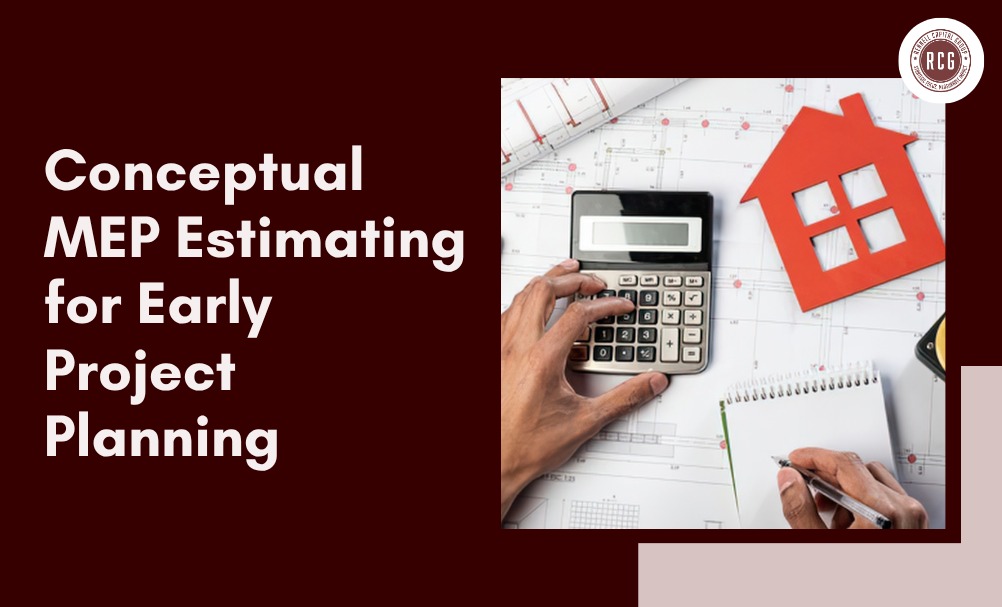
It happens on commercial builds almost every day. A developer advances deep into the design phase before anyone truly understands what the mechanical, electrical, and plumbing systems will actually cost. Suddenly, the budget explodes, causing massive delays and frustration. Project cost surprises rarely stem from structural elements. Instead, mechanical, electrical, and plumbing systems are the most variable and frequently underestimated line items during early planning.
A more reliable way to handle this issue is through conceptual MEP estimating. This approach gives project teams a real cost range early in the planning stage, even before the design is finalized.
This comprehensive guide covers everything you need to know about the process. We explain what it is, how it works, when to use it, and what it takes to do it correctly. You will also discover how an early stage MEP cost estimate can safeguard your entire investment strategy.
What Is Conceptual MEP Estimating?
To understand how to control project budgets, you must know that conceptual MEP estimating is the practice of developing early-stage cost ranges for mechanical, electrical, plumbing, and fire protection systems before full design drawings exist. This process gives owners a financial baseline right at the beginning of a venture.
You may recognize the clear difference between a conceptual estimate and a detailed bid estimate. The former acts as a crucial planning tool, while the latter functions as a procurement tool. At the start of a project, engineers and estimators do not have perfectly detailed blueprints. Rather than that, conceptual estimates are typically based on gross square footage, building type, occupancy parameters, system complexity assumptions, and historical cost benchmarks.
At certain stage, the information is still general, so estimates are less exact. A properly prepared conceptual estimate falls within a range of about 15% to 25% above or below final cost. This level of difference is normal and still helpful for early planning and decision-making.
Why Early-Stage MEP Cost Planning Changes Project Outcomes
Not estimating MEP costs early can create major issues later in a project. When cost details are unclear from the start, design decisions often move ahead without a proper understanding of their financial impact. Any changes made later usually cost more and become harder to implement. In many cases, project owners end up surprised by the final bid amounts, which can lead to delays, redesign work, or even stopping the project.
Mechanical, electrical, and plumbing systems even account for a large share of commercial construction costs, sometimes between 30% and 45% of the total budget. Even with this significant impact, many project teams delay creating a proper MEP budget until design is already well developed. This delay can lead to poor planning and costly mistakes that could have been avoided earlier in the process.
Executing conceptual MEP estimating at the schematic design or pre-design phase gives owners and developers the cost clarity they need. This intelligence helps teams make smarter decisions regarding system selections, overall project size, and general feasibility. Securing these numbers early also builds confidence. Reliable estimates play a massive role in securing financing, boosting investor confidence, and acquiring necessary internal project approvals. For targeted guidance, MEP pre-construction consulting offers the insight required to steer projects correctly from day one.
Key Inputs Required for a Conceptual MEP Estimate
A skilled estimator does not need completed drawings to produce a highly useful calculation. They simply need enough information to make educated, defensible assumptions.
Project Type and Occupancy
Different types of buildings come with very different cost requirements. Offices, hospitals, laboratories, warehouses, apartment buildings, and mixed-use projects each have their own MEP cost structure. On top of that, the level of system complexity and backup requirements can vary a lot depending on how the building will be used and how many people will occupy it each day.
Gross Square Footage and Floor Count
Square footage acts as the primary driver for material and labor quantities at the early planning stage. Multi-story buildings introduce significant vertical distribution costs. These include expensive additions like risers, dedicated shaft space, and additional equipment rooms required to service upper levels.
Location and Market Conditions
Labor costs in each region play a big role in the final estimate. Local building codes and current material prices also have a strong impact on overall project costs. For example, the same building can have very different MEP costs in Boston compared to Dallas because of differences in local wages, regulations, and market conditions.
System Assumptions
Estimators review the planned HVAC system in detail, if it’s variable air volume, variable refrigerant flow, chilled water systems, or packaged units. They also consider factors like electrical capacity and the number of plumbing fixtures required. When certain design details are still missing, these assumptions are clearly recorded and updated as the architectural plans develop. Learning how MEP quantity takeoff works helps show how these assumptions are turned into actual cost figures.
How Conceptual MEP Estimating Supports Pre-Construction Planning
An early budget is not something done in isolation. Conceptual MEP estimating connects directly with key pre-construction activities like feasibility studies, overall project budgeting, value engineering decisions, and selecting the main design criteria.
Early planning helps bring the entire project team onto the same page. It establishes clear and realistic cost expectations for the owner from the start. It also highlights expensive systems early so the team can consider more cost-effective options if needed. At the same time, it gives designers a defined budget to work within, helping ensure the final plans stay aligned with what can actually be funded.
When conceptual MEP estimates are skipped or done too late, projects even end up going over budget once bids come in. Many teams also use established industry resources, such as pre-construction cost estimating guides and ASHRAE recommendations for early-stage system selection, to help make more informed decisions about equipment and design choices.
Conceptual MEP Estimating vs. Detailed MEP Estimating: Know the Difference
Many people confuse early planning budgets with final bid numbers. Understanding the difference between conceptual MEP estimating and detailed estimating prevents costly miscommunications.
| Factor | Conceptual Estimate | Detailed Estimate |
|---|---|---|
| Stage | Pre-design / Schematic | Design Development / CDs |
| Accuracy | ±15–25% | ±5–10% |
| Inputs | SF, building type, assumptions | Full drawings + specs |
| Purpose | Budget setting, feasibility | Bidding, procurement |
| Time to Produce | Days | Weeks |
Both types of estimates play an important role in the construction process. One does not replace the other. A successful project uses a conceptual estimate early to guide planning and design decisions, followed by a detailed estimate before the project is sent out for bidding. For a deeper understanding of the later stage, many teams look into detailed MEP cost estimating services.
Common Mistakes in Early MEP Cost Planning
Many developers sabotage their own projects by making avoidable errors during the planning phase. Using a single dollar-per-square-foot allowance with no system assumptions behind it is a massive mistake. That approach is a mere guess, not a true calculation.
Another common mistake is allowing the design team to decide the MEP budget without getting an independent cost check. In many cases, fire protection expenses are also left out of early estimates, which later creates significant budget gaps. Project teams sometimes overlook required code updates as well, including energy efficiency rules, accessibility requirements, seismic standards, and local building regulations.
A severe lack of follow-through also hurts projects. Teams fail to revisit and update the estimate as the design evolves through the schematic and design development phases. They also treat the early numbers as a ceiling rather than a starting point for value engineering. Implementing proper construction cost control strategies may help teams avoid these exact pitfalls.
When Should You Commission a Conceptual MEP Estimate?
You should secure this estimate at the absolute earliest point when the building type, size, and general location are known. This often occurs before schematic design even begins.
For developers, commissioning this estimate must happen before committing to a site acquisition or locking in project financing. Owners should demand this calculation before approving a design contract or setting a finalized project budget. General contractors need these figures before submitting a design-build proposal or starting early contractor involvement engagements.
The earlier a conceptual MEP estimating report is in hand, the more value it delivers. Late estimates still help, but the window for making cost-shaping decisions narrows incredibly fast. To understand the timeline better, consult a real estate feasibility study guide. You can even verify baseline figures using tools like the RSMeans early-stage construction cost data.
How RCG Approaches Conceptual MEP Estimating
Rennell Capital Group approaches this process systematically to provide maximum clarity. The RCG process involves gathering strict project inputs, applying logical system-type assumptions, referencing highly current market pricing, and delivering a structured cost range backed by heavily documented assumptions.
RCG produces conceptual MEP estimating reports for commercial, healthcare, life sciences, industrial, and multi-family projects across a wide range of design stages.
These estimates arrive with incredibly clear documentation of exactly what is included, what is excluded, and what specific assumptions were made. Clients understand exactly what they are working with. RCG positions this service as a vital decision-support tool, far exceeding a simple number printed on a page. To see how this integrates with broader project execution, explore RCG’s MEP estimating and construction services.
Frequently Asked Questions (FAQ)
What is included in an MEP conceptual budget?
An MEP conceptual budget includes estimated costs for mechanical, electrical, plumbing, and fire protection systems based on square footage and building type. This pre-construction cost planning helps owners understand the rough order of magnitude MEP estimate before finalized blueprints exist.
How accurate is an early stage MEP cost estimate?
An early stage MEP cost estimate typically targets a ±15–25% accuracy range. Because full designs are absent, MEP project planning relies on historical data and system assumptions to provide a realistic MEP budget range for feasibility analysis.
Why is a schematic design cost estimate important?
A schematic design cost estimate prevents budget blowouts by identifying expensive systems early. Utilizing MEP pre-construction estimating allows project teams to make smart value engineering decisions, keeping the overall MEP feasibility estimate aligned with the owner’s financial goals.
Secure Your Project Budget Today
The single biggest mistake project teams make in early planning is treating MEP as a blank space to fill in later. By the time you possess finished drawings, your most impactful cost decisions are completely behind you.
Conceptual MEP estimating is not about down-to-the-penny precision. It provides project teams with the vital cost intelligence they need to plan, design, and commit capital with total confidence.
When your project is in early planning and you need a reliable MEP cost picture before design takes shape, Rennell Capital Group has the expertise to deliver. RCG’s team of experienced MEP estimators helps contractors, developers, and owners build smarter from day one with conceptual estimates grounded in real data, documented assumptions, and current market conditions. Contact Rennell Capital Group today to get started.

Looking for fresh content?
Get articles and insights from our weekly newsletter.
Recent Posts
Discuss a Project today!