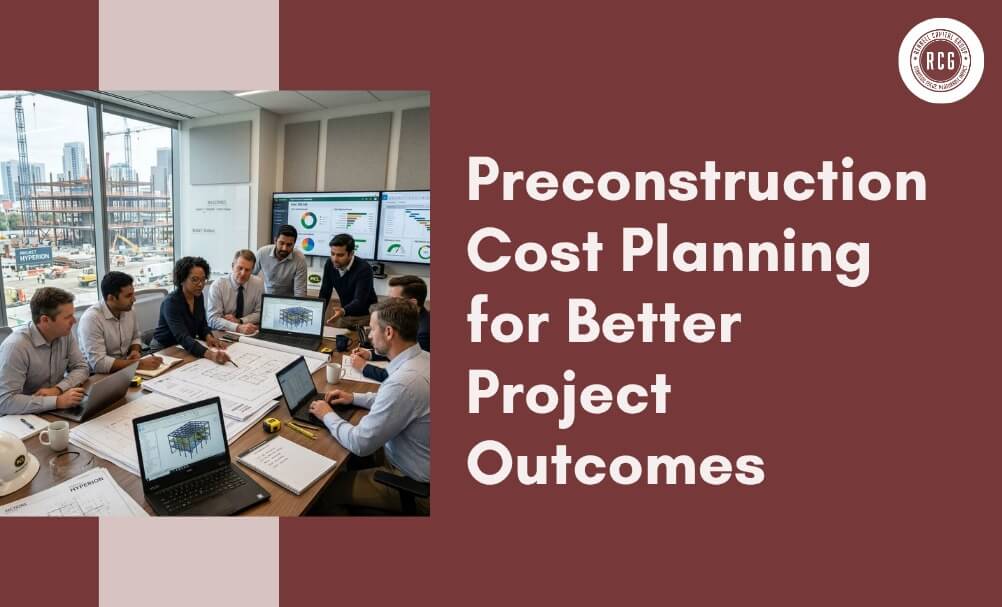
Construction projects rarely run into trouble because of one major mistake. More often, it’s a series of small issues that build up over time. A missing scope item, an underestimated material cost, or an inaccurate quantity may not seem major on its own, but together they may push a project over budget.
That’s why preconstruction cost planning is such an important part of any successful project. Taking the time to develop realistic budgets, review project scope, and identify potential risks early helps owners, developers, and contractors make better decisions before work begins.
Material and labor costs continue to climb, supply chains remain unpredictable, and design decisions made early can lock in millions of dollars in spending. With so much riding on choices made before the first shovel hits the ground, smart teams are investing more time and resources into early financial planning.
This guide explains what preconstruction cost planning is, why it matters, and how it works. You’ll learn the core objectives, the key components of an effective process, the challenges teams face, and the role technology and professional consultants play.
What Is Preconstruction Cost Planning?
Preconstruction cost planning is the discipline of building a realistic financial picture of a project before construction starts. It brings together budgeting, estimating, risk analysis, and forecasting into one structured process that guides decision-making during the earliest project phases.
The purpose is simple: align project’s design and ambitions with the money available to build it. While early development, owners and design teams make decisions which shape cost more than almost anything else. Choosing a structural system, mechanical approach, or finish level all carry long-term financial weight.
This stage sits at the very front of the project lifecycle, before detailed drawings are complete and well before contracts are signed. Successful projects almost always begin here. When the budget is grounded in reality and tied to a clearly defined scope, every later phase becomes easier to manage. Accurate preconstruction services give teams a stable foundation to design against, bid against, and build against.
Why Preconstruction Cost Planning Matters
The value of preconstruction cost planning shows up in four clear ways.
Budget certainty – A well-developed budget tells stakeholders what a project will actually cost, not what they hope it might cost. That certainty supports financing, approvals, and long-term planning.
Risk reduction – Construction risk management starts with identifying problems early. When teams spot certain gaps, design conflicts, or schedule pressures before construction starts, they may plan around them.
Better decision-making – Clear cost data may help owners weigh trade-offs. Should they expand the footprint or upgrade the systems? Reliable numbers turn tough choices into informed ones.
Stronger stakeholder confidence – Lenders, investors, and partners trust projects that demonstrate financial discipline. A solid cost plan signals that the team knows the numbers and the risks.
Consider what happens without this discipline. A developer who skips thorough early planning may approve a design which looks affordable on paper, only to discover during bidding that mechanical and electrical systems blow past the budget.
The Key Objectives of Preconstruction Cost Planning
Strong project budget planning works toward several connected goals.
Establishing Realistic Budgets
The first objective is creating a budget the team can actually trust. Realistic numbers account for the full scope, market conditions, and appropriate contingencies. An honest budget protects everyone, even when the figure is higher than hoped.
Improving Cost Visibility
Good planning makes cost transparent. Stakeholders should understand where the money is going and why. Breaking the budget into clear categories helps teams track spending and spot trouble early.
Reducing Financial Risk
Construction financial planning is partly about protecting the project from surprises. By identifying risks and assigning contingencies, teams reduce the chance that a single issue derails the budget.
Supporting Strategic Decision-Making
Cost planning gives leaders the information they need to make smart calls. Whether choosing between design options or deciding whether to proceed at all, decisions improve when they rest on solid cost data.
Improving Project Feasibility
Construction feasibility analysis answers a basic question: does this project make financial sense? Early planning helps owners confirm that a project is viable before they commit major resources.
Key Components of an Effective Preconstruction Cost Planning Process
A reliable cost planning process moves through several stages, each building on the last. Skipping any one of them weakens the whole effort.
Project Scope Definition
Everything starts with scope. The team must define exactly what the project includes; its size, systems, quality level, and performance goals. This means capturing owner expectations clearly and documenting them in detail.
Scope clarity is the foundation of accurate budgeting. When the scope is vague, the estimate becomes a guess. When it’s well defined, every later step has something solid to build on.
Conceptual Cost Estimating
With scope in hand, teams move to conceptual estimating. At early stage, drawings are incomplete, so estimators rely on benchmarks, historical data, and unit costs to produce preliminary estimates.
Conceptual cost estimating is less about pinpoint accuracy and more about direction. It tells the team whether the project is in the right financial neighborhood and where the big cost drivers sit. As design develops, these estimates become more refined.
Quantity Takeoffs and Cost Analysis
As project plans become more detailed, estimators begin preparing quantity takeoffs to determine the materials, labor, and equipment needed for construction. This step provides the information required to develop a more accurate project budget.
A quantity takeoff converts drawings into measurable values, such as an amount of concrete required, the length of piping, or the square footage of flooring and finishes. These quantities are then combined with current material prices, labor costs, and equipment rates to prepare a detailed cost estimate.
Reviewing these quantities carefully also helps identify missing items, inconsistencies, or potential budget issues before construction starts.
Market Pricing Evaluation
Numbers only matter if they reflect real market. Material escalation, labor trends, and supply chain conditions all shift over time, sometimes dramatically.
A good cost plan considers how prices may change before materials are purchased. If steel or copper is trending upward, the budget should reflect that. Ignoring market reality is one of the fastest ways to fall short.
Risk Assessment and Contingency Planning
Every construction project involves some level of uncertainty, which is why effective cost control includes planning for potential risks. Before work begins, project teams look at factors such as design changes, procurement challenges, schedule delays, and other issues that could affect the budget or timeline.
Based on those risks, a contingency allowance is built into the project budget. This is not extra money added without purpose; it is a planned reserve for certain situations that can’t be predicted.
The amount of contingency should reflect the complexity of the project. For example, a renovation with unknown site conditions will usually require a larger contingency than a new construction project with a well-defined scope and fewer uncertainties.
How Preconstruction Cost Planning Improves Project Outcomes
When done well, early cost planning pays off across the entire project.
- Better budget management. Teams that plan thoroughly spend with confidence and stay closer to their targets throughout construction.
- Fewer change orders. Catching scope gaps and conflicts early dramatically reduces costly changes which derail schedules and budgets later.
- Improved scheduling. Accurate cost and scope information supports realistic timelines and smoother procurement.
- Greater profitability. For contractors, a tight cost plan protects margins. For owners, it protects returns.
- Stronger stakeholder confidence. A disciplined approach reassures lenders, investors, and partners that the project is in capable hands.
The pattern is consistent: money and effort spent on planning return far more value than they cost.
Common Cost Planning Challenges in Construction
Even experienced teams face obstacles during the planning phase. Knowing them in advance helps you manage them.
- Incomplete project information. Early budgets must be built before all the details are known, which makes assumptions unavoidable. The key is documenting those assumptions clearly.
- Scope creep. As stakeholders add requirements, costs climb quietly. Without any tight scope control, budget may lose its footing.
- Market volatility. Prices for materials and labor may swing fast, undermining estimates that don’t account for change.
- Labor shortages. A tight labor market drives up costs and stretches schedules, especially for specialized trades.
- Design changes. Every revision may ripple through the budget. Managing changes carefully keeps surprises in check.
The Role of Technology in Modern Cost Planning
Technology has changed the way construction teams estimate costs and manage project budgets. Many tasks that once required hours of manual work can now be completed more quickly and with greater accuracy, making it easier for teams to stay aligned throughout a project.
Building Information Modeling (BIM) allows estimators to extract quantities directly from a digital model, reducing manual measurements and helping improve consistency. Digital estimating software even makes it easier to organize cost information, update estimates, and keep everyone working with the latest data.
Many teams also depend on construction cost databases to compare estimates with current market pricing and data from similar projects. This may help improve budgeting and supports more informed decision-making.
Newer tools are also making it easier to forecast future costs. By checking market trends and historical data, predictive analytics may help teams identify potential risks and prepare for changes before they affect the project. At the same time, cloud-based platforms allow owners, designers, estimators, and contractors to access the same information, making collaboration simpler and reducing the chance of costly miscommunication.
Together, these technologies help project teams make more informed decisions, improve cost accuracy, and manage projects with greater confidence.
Value Engineering as Part of Preconstruction Cost Planning
Value engineering is one of the most powerful tools in the planning toolkit. It’s a structured way to find cost-saving opportunities without sacrificing function or quality.
The process looks for smarter ways to deliver the same performance. That might mean substituting materials, refining a design detail, or rethinking how a system is built. Effective value engineering services weigh both upfront cost and long-term value, so savings today don’t create higher expenses tomorrow.
Done right, value engineering optimizes design and creates lasting value. It may keep a project within budget while protecting the qualities that matter most to an owner, a balance that takes real expertise to strike.
Best Practices for Successful Preconstruction Cost Planning
A few habits separate strong cost planning from weak attempts.
- Involve stakeholders early – Bring owners, designers, and cost experts together at start so everyone shares the same goals and assumptions.
- Update budgets regularly – Treat budget as a living document that evolves as design develops, not a one-time figure.
- Estimate accurately – Base numbers on real data, clear scope, and current pricing rather than optimism.
- Assess risk continuously – Revisit risks throughout planning, since new ones emerge as the project takes shape.
- Plan collaboratively – The best outcomes come from teams that communicate openly and solve problems together.
Why Contractors and Owners Invest in Professional Cost Planning Services
Many teams turn to specialists for cost planning, and the reasons are practical.
Professional services sharpen forecasting by drawing on deep experience and current market data. They also provide independent cost validation; an objective second set of eyes that confirms the numbers are sound. That independence is especially valuable for owners who want assurance that their budget reflects reality.Better cost planning also supports stronger investment decisions.
When owners and investors trust the numbers, they can commit capital with confidence. And throughout the process, experienced consultants help mitigate risk by spotting issues others might miss. The investment in professional capital planning for construction often pays for itself many times over.
How Professional Consultants Support Better Project Outcomes
Experienced consultants do more than prepare cost estimates. They bring practical industry knowledge, an understanding of current market conditions, and the insight needed to help owners make informed decisions throughout a project’s lifecycle.
Their role often extends well beyond the early planning stages. As the design develops, they monitor how changes affect the budget, identify potential cost concerns, and suggest adjustments before such issues become much expensive to address.
For additional guidance on cost planning and project performance, owners and contractors can also refer to industry resources such as the National Institute of Building Sciences and the Construction Industry Institute, which publish research, best practices, and technical guidance for the construction industry.
Build with Confidence from the Start
Strong projects are shaped long before construction begins. Preconstruction cost planning gives owners, developers, and contractors the budget certainty and proactive risk management they need to avoid costly surprises and keep projects on track.
The payoff reaches far beyond a single phase. Accurate estimating and disciplined budgeting lessen change orders, protect schedules, strengthen profitability, and build trust with stakeholders.
If you’re planning a project and want that level of certainty, consider partnering with experts who understand both construction and capital. Rennell Capital Group brings together MEP estimating and consulting services, owner representation services, construction management expertise, and capital advisory solutions to help you plan smarter, reduce risk, and deliver better project outcomes.
Frequently Asked Questions
What is preconstruction cost planning?
Preconstruction cost planning is the process of developing budgets, evaluating risks, forecasting costs, and establishing financial expectations before construction begins.
Why is preconstruction cost planning important?
It helps improve budget accuracy, reduce financial risk, support decision-making, and increase the likelihood of project success.
What is included in a preconstruction cost plan?
A cost plan typically includes conceptual estimates, quantity takeoffs, market pricing analysis, risk assessments, and contingency planning.
How does cost planning reduce project risk?
Cost planning identifies potential budget challenges early, allowing project teams to address risks before they impact construction.
Should owners use professional cost planning consultants?
Professional consultants provide expertise, independent cost validation, and strategic insights that improve project outcomes and cost certainty.

Looking for fresh content?
Get articles and insights from our weekly newsletter.
Recent Posts
Discuss a Project today!