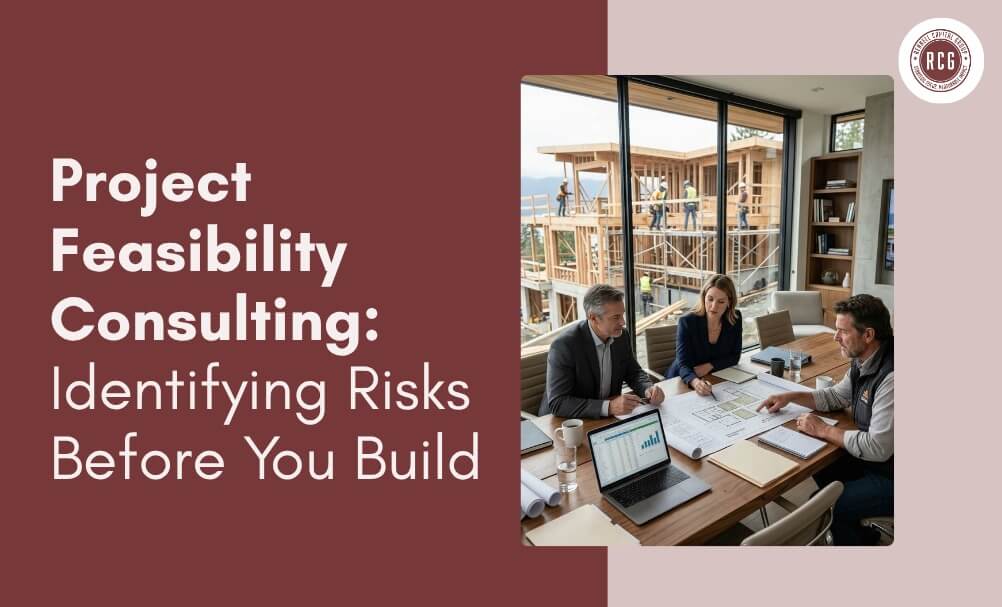
Every successful development project starts with asking the right questions early. What will the project actually cost? Is there enough market demand? Does the site support what is being planned? These are the kinds of questions that can shape success or failure of a project.
The price of discovering a problem too late can be staggering. A zoning restriction overlooked during planning, a market which softens before lease-up, a soil condition that triples foundation costs, any one of these may turn a project into a financial drain. The further along you are, the more expensive it becomes to fix.
This is where project feasibility consulting earns its keep. By studying a development’s financial, physical, and regulatory realities before construction begins, feasibility analysis helps developers, investors, and property owners separate sound opportunities from risky ones. In this guide, you’ll learn what feasibility consulting involves, the risks it uncovers, the step-by-step process behind it, and why professional analysis often pays for itself many times over.
What Is Project Feasibility Consulting?
Project feasibility consulting is the practice of evaluating whether a proposed development makes sense before you commit serious money to it. Think of it as a stress test for your idea. Consultants examine the numbers, the location, the market, and the rules that govern the project, then give you an honest read on whether it can succeed.
The core purpose is support informed decision-making. Rather than fully relying on gut feelings or assumptions, you may get a clear-eyed assessment grounded in research and data. That assessment covers four main pillars:
- Financial analysis – projecting costs, revenue, and returns to confirm the project pencils out.
- Site evaluation – checking whether the location and land can support what you intend to build.
- Market research – measuring real demand and studying the competition.
- Risk identification – flagging the obstacles that could derail timelines, budgets, or approvals.
A thorough development feasibility analysis pulls these threads together into a single picture. The result helps you decide whether to move forward, adjust your plans, or walk away entirely while the cost of changing course is still low.
Why Project Feasibility Consulting Matters Before Construction Begins
Construction is the point of no return for most of your budget. Once crews mobilize and materials arrive, your flexibility shrinks fast. A project risk assessment performed beforehand protects your resources while you still have room to adapt.
Reduces Financial Uncertainty
Development carries real financial exposure. A feasibility study replaces guesswork with grounded projections, giving you a realistic view of costs, revenue, and returns. You learn whether the expected profit justifies the risk before you stake your capital on it.
Supports Better Planning
Good plans rest on good information. Feasibility analysis surfaces the details that shape design, scheduling, and financing decisions. Knowing your constraints early means you can build a plan around reality rather than scrambling to fix surprises later.
Improves Budget Accuracy
Vague budgets sink projects. A construction feasibility review digs into the actual costs labor, materials, permits, financing, contingencies so your budget reflects what the work will truly demand. That accuracy keeps funding requests credible and lenders confident.
Helps Avoid Costly Delays
Many delays trace back to issues that a feasibility study would have caught. A missing permit, an unsuitable site condition, or a financing gap can stall a project for months. Identifying these roadblocks early keeps your timeline intact and your costs under control.
Key Areas Evaluated During a Feasibility Study
A complete feasibility study looks at a project from several angles. Each one tests a different assumption that, if wrong, could undermine the whole venture.
Market Feasibility
Market feasibility asks a basic question: will people want what you’re building? Analysts study:
- Demand analysis — measuring how much appetite exists for the product, whether that’s apartments, retail space, or industrial units.
- Competition review — mapping out competing projects and how they perform.
- Demographic trends — examining population growth, income levels, and shifts that affect long-term demand.
Site Feasibility
Even a strong market won’t save a poor location. Site selection analysis evaluates:
- Location suitability — whether the site fits the intended use.
- Access and infrastructure — roads, utilities, and services that the project depends on.
- Environmental considerations — soil quality, flood risk, contamination, and other physical factors.
Financial Feasibility
Financial feasibility is where ambition meets arithmetic. Investment feasibility analysis covers:
- Development costs — the full price of bringing the project to completion.
- Funding requirements — how much capital you need and where it will come from.
- Cash flow projections — the timing of money in and money out across the project’s life.
Regulatory Feasibility
Rules can make or break a development. Regulatory feasibility examines:
- Zoning compliance — whether the project is allowed on the site as planned.
- Permitting requirements — the approvals you’ll need and how long they take.
- Local regulations — building codes, density limits, and other restrictions specific to the area.
Common Risks Identified Through Project Feasibility Consulting
The real value of project feasibility consulting lies in catching threats before they cost you. Here are the risks a strong feasibility study tends to expose.
Budget Risks
Cost overruns are among the most common reasons projects fail. Feasibility analysis tests your budget against realistic figures, revealing where estimates fall short before those gaps become emergencies.
Market Risks
Demand can shift between planning and completion. A feasibility study measures current conditions and trends, helping you judge whether the market will still support your project when it’s ready to open.
Construction Risks
Site conditions, material availability, and labor shortages can all disrupt a build. Identifying these factors early lets you plan around them instead of reacting to them mid-construction.
Regulatory Risks
A project that conflicts with zoning or fails to secure permits can stall indefinitely. The Corporate Finance Institute (CFI) notes that due diligence exists to lower risk and improve the success of major investments, and regulatory review is a key part of that work. Catching a compliance issue early can save months of frustration.
Timeline Risks
Unrealistic schedules cost money. Feasibility analysis assesses whether your proposed timeline is achievable given permitting, financing, and construction realities, so you can set expectations you can actually meet.
How Project Feasibility Consulting Improves Decision-Making
Decisions are only as good as the information behind them. Project feasibility consulting strengthens that foundation in several ways.
First, it delivers an objective evaluation. An independent analysis isn’t swayed by the excitement of a deal; it tells you what the data shows, even when the answer isn’t what you hoped to hear.
Second, it enables data-driven planning. A sound development planning strategy based on facts about the market, the site, and the finances. Feasibility analysis supplies those facts, so plan rests on evidence rather than optimism.
Third, it surfaces challenges before commitments are made. The best time to know about a problem is while you may still respond cheaply. Feasibility work reveals issues early, when adjusting course costs far less than it would later.
Finally, it supports smarter capital allocation. A clear investment feasibility analysis helps you decide where your money will work hardest, so you can back projects with the strongest prospects and pass on the rest.
A Step-by-Step Feasibility Assessment Process
A feasibility study follows a logical path from broad goals to specific recommendations. Here’s how the process generally unfolds.
Step 1: Define Project Objectives
Start by clarifying what you want to achieve. The project’s goals, scope, and intended use shape every analysis that follows.
Step 2: Gather Market Data
Collect information on demand, competition, and demographics. This data shows whether a viable market exists for the project.
Step 3: Evaluate Site Conditions
Assess the location, infrastructure, access, and environmental factors. Site selection analysis confirms whether the land can actually support your plans.
Step 4: Analyze Financial Viability
Build out cost estimates, funding needs, and cash flow projections. This step tests whether the numbers support a worthwhile return.
Step 5: Assess Risks and Constraints
Identify the budget, market, construction, regulatory, and timeline risks that could threaten the project. According to the Project Management Institute (PMI), structured assessment early in a project’s lifecycle is essential to managing uncertainty effectively.
Step 6: Develop Recommendations
Pull every finding together into clear guidance, proceed, revise, or stop. This is where analysis turns into a practical decision you can act on.
Common Mistakes Developers Make Without a Feasibility Review
Skipping a feasibility review rarely saves money in the long run. These are the mistakes that most often follow when developers move ahead without one:
- Purchasing unsuitable sites — buying land that can’t support the intended project because of zoning, access, or environmental limits.
- Underestimating project costs — relying on optimistic budgets that ignore contingencies and rising expenses.
- Overlooking zoning issues — assuming a use is permitted, only to face costly variances or redesigns.
- Setting unrealistic timelines — planning schedules that don’t account for permitting and construction delays.
- Inadequate due diligence — failing to verify the assumptions that the entire project depends on.
Each of these errors is preventable. A project viability assessment catches them before they translate into lost time and money.
The Connection Between Feasibility Analysis and Capital Planning
Feasibility and finance work hand in hand. A solid feasibility study feeds directly into stronger capital planning by grounding financial decisions in real analysis.
It sharpens budgeting by replacing rough estimates with researched figures. It informs funding strategy by clarifying how much capital a project needs and when. It guides capital allocation by showing which opportunities offer the best risk-adjusted returns. And it supports project prioritization when you have more ideas than resources to pursue them.
A disciplined capital planning strategy relies on this kind of insight. When a project viability assessment confirms that the numbers hold up, you can commit capital with confidence rather than crossing your fingers.
Why Professional Feasibility Consulting Matters
You can attempt a feasibility study in-house, but professional consulting brings advantages that are hard to replicate. The biggest is independence. An outside analysis isn’t tied to the excitement of a particular deal, so its recommendations stay objective.
Professional consultants also bring depth of experience. They’ve seen which assumptions tend to fail and which risks get overlooked, and they know how to test a project against real-world conditions. Working with an experienced capital advisory team can help developers evaluate opportunities more thoroughly and identify potential risks before significant resources are committed.
Beyond the initial study, professional advisors support long-term planning. They help connect feasibility findings to financing, project oversight, and huge investment goals turning a one-time analysis into ongoing risk reduction across life of a development.
Build on a Foundation of Facts, Not Hope
Successful projects are rarely the result of chance. They begin with careful planning, thorough analysis, and a clear knowing of the risks and opportunities involved. Project feasibility consulting might even help developers check vital factors before construction starts, lessens uncertainty and improving decision-making.
Identifying potential challenges early can help avoid costly delays, budget overruns, and unexpected obstacles later in the process.
At Rennell Capital Group, our Capital Advisory team works with developers, investors, and owners to evaluate project opportunities through detailed analysis and strategic planning. By combining feasibility insights with financial planning and project oversight expertise, we help clients approach development with greater clarity and confidence.
When informed decisions are made before construction begins, projects are better positioned for long-term success and stability.
Frequently Asked Questions on Project Feasibility Consulting
What is the difference between a feasibility study and due diligence?
A feasibility study consulting evaluates whether a proposed project can succeed by examining market, site, financial, and regulatory factors. Due diligence consulting verifies the facts behind a specific transaction or investment. The two often overlap, and feasibility analysis frequently includes due diligence work.
When should I commission a feasibility study?
The best time is early, before you purchase a site or commit major capital. Running a feasibility study consulting at the planning stage gives you room to adjust your approach or walk away while changing course is still inexpensive.
How long does a feasibility study take?
Timelines vary with the size and complexity of the project. A focused study may take a few weeks, while a large or complicated development can require several months of market research, site evaluation, and financial analysis.
Does a feasibility study consultation guarantee a project will succeed?
No analysis can promise success. A feasibility study reduces risk by giving you accurate information and identifying problems early, but markets and conditions can still change. Its value lies in helping you make better-informed decisions.

Looking for fresh content?
Get articles and insights from our weekly newsletter.
Recent Posts
Discuss a Project today!