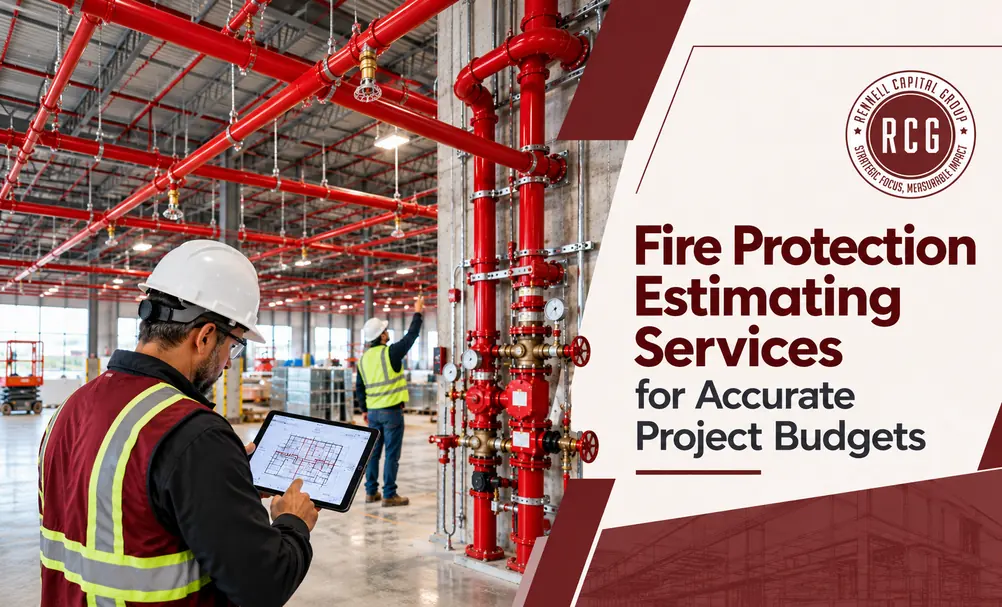
Fire protection estimating services help contractors, owners, and developers plan the cost of fire safety systems before construction begins. These services calculate the expected costs of sprinkler pipes, valves, pumps, fittings, and installation labor.
Fire protection systems are an important part of any commercial building. Their costs depend on the building size, system design, materials, and safety needs. Even a small mistake in counting materials or planning labor can lead to extra costs later.
A detailed fire protection estimate starts with a careful review of project drawings and plans. It helps teams understand material needs, check equipment costs, and prepare a clear budget. It can also find missing items before contractors submit bids or begin construction.
With accurate cost information, owners can plan their spending, and contractors can prepare more reliable bids. This helps reduce budget problems and avoid costly changes during the project.
In this article, we explain what fire protection estimating services include, what affects system costs, and how to choose the right estimating partner for your project.
What Are Fire Protection Estimating Services?
Fire protection estimating services quantify and price the fire suppression scope shown on a project’s construction documents. An estimator reviews fire protection plans, risers, device schedules, reflected ceiling plans, and specifications to measure materials, calculate labor, and compile a cost estimate that supports bidding, budgeting, or preconstruction planning.
These services are used by fire protection subcontractors, general contractors, developers, owners, and construction managers anyone who needs cost visibility before committing to a design or a bid.
It’s worth drawing a clear line here: estimating is not the same as engineering or hydraulic design. A fire protection estimate quantifies what’s documented on the drawings; it doesn’t calculate water demand, design the system, or produce stamped submissions unless that work is specifically scoped and included.
What’s Included in a Fire Protection Cost Estimate?
A thorough fire protection estimate typically breaks the system into several component categories:
Sprinkler heads. Quantities, types, and finishes, counted and matched to the documented coverage areas and hazard classification.
Fire protection piping. Branch lines, cross mains, feed mains, and risers, organized by size and material since a run of 1-inch branch line and a 4-inch main carry very different material and labor costs per foot.
Fittings and valves. Elbows, tees, reducers, couplings, control valves, check valves, and flow switches.
Fire pumps and equipment. Fire pumps, jockey pumps, controllers, and other documented equipment where the project includes them.
Hangers, supports, and bracing. Often overlooked in favor of piping totals alone, these items add real cost and deserve their own line items particularly where seismic bracing applies.
Labor. Installation, handling, testing, and commissioning labor tied to the documented scope.
A good estimate also comes with scope notes, assumptions, and exclusions so everyone reviewing it understands exactly what’s priced and what isn’t.
How Fire Protection Estimating Improves Budget Accuracy
Detailed estimating doesn’t guarantee a project stays on budget, but it meaningfully reduces cost risk. Here’s how:
- It creates a clearer cost baseline for the fire protection scope, rather than relying on a broad percentage-based allowance.
- It identifies missing scope before it becomes an expensive surprise mid-construction.
- It improves the accuracy of material quantities by counting components individually rather than estimating by rule of thumb.
- It supports better labor planning by tying hours to actual pipe sizes, fitting counts, and installation conditions.
- It gives owners and GCs a defensible basis for reviewing contractor bids and catching outliers.
- It improves procurement planning, since material quantities are known earlier in the process.
The result is better budget visibility and fewer unpleasant surprises not a guarantee against every possible cost fluctuation.
Why an Accurate Fire Sprinkler Takeoff Matters
The relationship is straightforward: plans and specifications feed the takeoff, the takeoff drives material and labor pricing, and that pricing becomes the estimate that informs the budget. Skip or rush any step, and the error carries through to the final number.
A thorough takeoff counts sprinkler heads, pipe by size, fittings, valves, hangers, risers, standpipes, fire pumps, and accessories individually. Pipe diameter and material affect both material cost and labor hours, which is exactly why broad per-square-foot allowances tend to miss the mark on anything beyond the simplest layout. Detailed, component-level takeoffs give a far more reliable foundation for both budgeting and bidding.
What Factors Affect Fire Protection System Costs?
Several variables influence the final cost of a fire protection system, including:
- Building size and layout. More square footage and more complex layouts mean more piping, more heads, and more labor.
- Occupancy and hazard classification. Light hazard and ordinary hazard spaces require very different sprinkler densities and head counts, even across similar floor plates.
- System type. Wet pipe, dry pipe, preaction, and deluge systems carry different material and labor requirements.
- Pipe material and size. Steel, CPVC, and copper piping all price differently, as do the various diameters used throughout a system.
- Fire pumps and specialty equipment. Larger or more complex buildings may require fire pumps, controllers, and additional equipment that add real cost.
- Labor rates and installation conditions. Ceiling height, access, and project phasing all affect productivity and labor hours.
- Project location. Local labor rates and material markets vary significantly across regions.
- Existing building conditions. Retrofit and renovation work often carries higher labor costs than new construction due to access constraints and unknowns.
Fire protection systems must also be designed and installed according to applicable codes and standards. For automatic sprinkler systems, NFPA 13 is the industry benchmark, addressing system design approaches, installation requirements, and component options. These requirements shape which components a system includes and, by extension, what it costs to build.
Common Fire Protection Estimating Mistakes
Even experienced teams run into avoidable errors when estimating fire protection scope:
- Missing sprinkler heads or sections of piping during the takeoff
- Using incorrect pipe sizes or quantities
- Overlooking valves and fittings that don’t appear clearly on the drawings
- Forgetting hangers, supports, and seismic bracing
- Missing fire pump or standpipe scope on larger buildings
- Pricing against outdated material costs
- Underestimating labor for complex installation conditions
- Failing to incorporate the latest drawing revisions or addenda
Most of these mistakes come down to rushing the takeoff or working from incomplete documents both of which a structured estimating process is designed to catch.
How Fire Protection Estimating Supports Better Contractor Bids
Missing scope on a bid creates margin risk once the project is underway. Padding a bid with excessive allowances to cover uncertainty creates a different problem: a less competitive number. A detailed fire protection estimate gives bidders a clearer basis for pricing decisions by accounting for material quantities, labor requirements, current supplier pricing, and documented assumptions and exclusions reducing the guesswork on both sides of the bid.
When Should You Use Professional Fire Protection Estimating Services?
Professional estimating adds the most value during early budgeting, preconstruction planning, contractor bidding, and independent estimate review. It’s also worth bringing in dedicated estimating support for complex projects, significant design updates, change order review, or when internal estimating resources are stretched thin.
How to Choose a Fire Protection Estimating Company
Look for a provider with specific fire protection and MEP/FP estimating experience not just general construction estimating. Review the quality of their deliverables: detailed quantity takeoffs, marked-up drawings, organized spreadsheets, and explicit assumptions, inclusions, and exclusions all signal a rigorous process. Ask how they handle drawing revisions and addenda, and confirm they understand labor costing in addition to material pricing. A clear, well-documented deliverable is often the best indicator of estimating quality.
Build More Accurate Fire Protection Budgets
Accurate fire protection estimating helps contractors, owners, and developers plan their budgets before construction begins. It gives project teams a clear idea of material quantities, equipment prices, labor needs, and other costs that may affect the project.
A detailed estimate covers important parts of the fire protection system, including sprinkler pipes, heads, valves, pumps, fittings, and supports. It also helps teams find missing items, review costs, and make changes before work starts.
Fire protection estimating services can help contractors prepare better bids and avoid unexpected expenses. With a clear budget, owners can plan their spending and make informed decisions throughout the project.
Rennell Capital Group provides professional MEP/FP estimating and construction cost advisory services for commercial construction projects. Our team works with contractors, owners, and preconstruction teams to review project plans, check material quantities, and prepare reliable cost estimates.
We understand that every building has different fire protection needs. That is why careful planning and accurate cost information matter from the start.
Whether you are preparing a bid or planning a new building, we can help you understand your fire protection costs.
Need help with your project budget? Contact Rennell Capital Group today to discuss your estimating needs.
Frequently Asked Questions
What are fire protection estimating services?
Fire protection estimating services quantify and price the fire suppression scope shown on construction documents, covering materials like piping, sprinkler heads, valves, and pumps, along with associated labor.
What is included in a fire sprinkler estimate?
A fire sprinkler estimate typically includes sprinkler heads, piping, fittings, valves, fire pumps, hangers, and labor costs, along with documented assumptions and exclusions.
What is a fire sprinkler takeoff?
A fire sprinkler takeoff is the process of measuring and counting system components piping, heads, valves, and accessories directly from project drawings and specifications.
How are fire protection system costs estimated?
Costs are estimated by combining material takeoff quantities with current pricing and labor rates, adjusted for project-specific factors like building layout and system type.
What factors affect fire sprinkler installation costs?
Building size, occupancy and hazard classification, system type, pipe material and size, equipment needs, labor rates, and project location all influence installation costs.
Who needs professional fire protection estimating services?
Fire protection contractors, general contractors, developers, owners, and preconstruction teams all use these services to support budgeting, bidding, and cost review.

Looking for fresh content?
Get articles and insights from our weekly newsletter.
Recent Posts
Discuss a Project today!