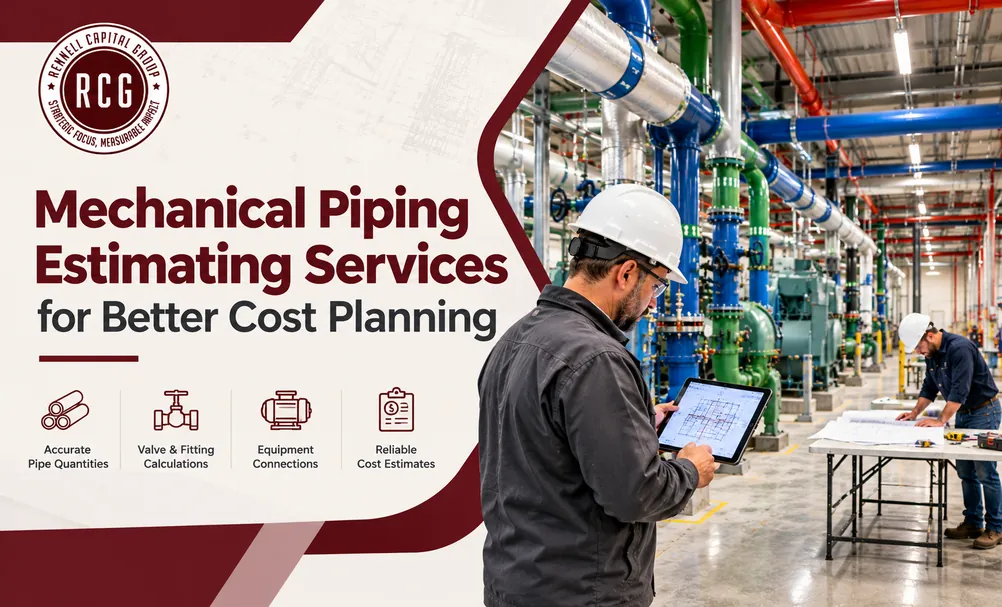
Mechanical piping estimating services help contractors, owners, and developers understand the cost of installing piping systems before construction begins. These services calculate material quantities, equipment prices, labor costs, and other expenses needed to complete the work.
Mechanical piping is an important part of many commercial buildings. Its cost depends on pipe sizes, materials, fittings, valves, insulation, and installation needs. Some buildings have complex piping systems with many connections and different pipe types. Missing even a small item can increase costs and cause budget problems later.
A detailed piping estimate starts with a careful review of project drawings and plans. It helps teams count materials, check labor needs, compare prices, and prepare a realistic budget. Accurate estimates also help contractors submit better bids and avoid unexpected expenses during construction.
In this guide, we explain what mechanical piping estimating services include, why accurate material takeoffs matter, and which factors affect piping costs. You will also learn how early cost planning helps owners, developers, and contractors manage budgets and make better decisions before work begins.
What Are Mechanical Piping Estimating Services?
Mechanical piping estimating involves reviewing drawings, risers, flow diagrams, schedules, and specifications to determine quantities and expected costs for the mechanical piping scope of a project. The estimator works through each system methodically, converting design documents into a priced bill of materials and labor.
A complete mechanical piping estimate typically accounts for:
- Pipe, organized by system, material, and diameter
- Fittings such as elbows, tees, reducers, and couplings
- Valves, including isolation, balancing, and control types
- Hangers and supports
- Insulation where included in scope
- Mechanical equipment connections
- Labor for installation, joining, and testing
This process serves several groups across a construction project, including mechanical contractors, general contractors, owners, developers, construction managers, and preconstruction teams. Each relies on these estimates differently contractors use them to build competitive bids, while owners and developers use them to validate budgets before committing capital.
The general workflow mirrors standard preconstruction practice: documents are gathered, the scope is reviewed, quantities are taken off, pricing is applied, the estimate undergoes quality review, and a final number is delivered.
What Is Included in a Mechanical Piping Estimate?
A thorough mechanical piping estimate breaks the project into distinct components rather than pricing the system as a single lump sum. Here’s what that typically looks like.
Pipe
Pipe quantities are organized by system, material, and diameter. A chilled water main carries different cost and labor implications than a small-diameter heating hot water runout, even if both appear on the same set of drawings.
Fittings
Elbows, tees, reducers, couplings, and other connection points are counted individually. On complex systems, fittings can represent a meaningful share of total piping cost.
Valves
Isolation, balancing, control, check, and other valve types shown in the project documents are tallied and priced according to size and function.
Hangers and Supports
Pipe supports, hangers, and related installation requirements, including seismic bracing where applicable, are quantified to reflect actual spacing and structural conditions.
Insulation
Pipe insulation and related accessories are measured separately when included in the piping scope, since insulation is often handled as its own subcontract.
Mechanical Equipment
Pumps, boilers, chillers, heat exchangers, and the piping connections tied to this equipment are identified and priced, along with any rigging or setting requirements.
Labor
Installation, joining, equipment connections, testing, and other defined labor tasks are estimated based on joint type, pipe size, and site conditions.
This component-level approach reflects how experienced mechanical estimators structure their takeoffs. Rather than applying a flat rate per linear foot, each element is measured and priced on its own terms.
How Mechanical Piping Estimating Services Improve Cost Planning
Detailed piping estimates give project teams the visibility they need to make informed financial decisions. They help establish realistic budgets grounded in actual scope rather than historical averages, and they make the major cost drivers of a project visible early, before those costs become locked in by design decisions.
A thorough estimate also helps identify missing scope before it turns into a change order, improves material planning and procurement timing, and supports more accurate labor forecasting. Project teams can use these estimates to compare contractor bids on equal footing, evaluate the cost impact of design changes, and track budget updates as a project develops.
The underlying logic is simple: better quantities lead to better pricing, better pricing leads to better budget visibility, and better budget visibility leads to better cost decisions. That said, no estimate, however detailed, can guarantee a project will avoid cost overruns. What an accurate estimate does provide is a clearer, earlier picture of where risk is likely to emerge.
Why an Accurate Mechanical Piping Takeoff Matters
The path from design to budget runs through the takeoff: mechanical drawings inform the piping takeoff, which generates material quantities, which inform labor estimates, which inform pricing, which produces the cost estimate, which ultimately shapes the project budget. Each step depends on the accuracy of the one before it.
A proper takeoff measures pipe lengths, diameters, and materials system by system. It also accounts for fittings, valves, connections, supports, insulation, and equipment connections not just the pipe runs themselves. Fittings and connections, in particular, should be reviewed individually rather than priced as a percentage of pipe footage, since joint-heavy areas like mechanical rooms and equipment connections can carry disproportionate cost relative to the length of pipe involved.
What Types of Mechanical Piping Systems Are Estimated?
Mechanical piping estimators work across a range of system types, each with its own quantification requirements.
Chilled Water Piping
Supply and return piping for cooling loads, typically sized by diameter and measured separately by material: carbon steel for mains, copper for smaller runouts.
Heating Hot Water Piping
Distribution piping serving coils, fan units, and terminal devices, often sharing routing with chilled water in combined hydronic systems.
Steam and Condensate Piping
Steam distribution and the associated pumped or gravity condensate return lines, which require attention to pressure rating and joining method.
Refrigerant Piping
Piping connecting cooling equipment, sometimes carried by the equipment vendor rather than the mechanical contractor, depending on project delivery.
Condensate Piping
Drain and return lines associated with cooling coils and steam systems, measured for both material and routing complexity.
Process and Utility Piping
Compressed air, process water, and other utility piping included when it falls within the mechanical construction scope defined by the documents.
Hydronic, chilled water, steam, condensate, gas, and process systems make up the core scope that commercial mechanical estimators consistently account for, making each one relevant to any serious piping estimate.
What Factors Affect Mechanical Piping Costs?
Several variables drive the final cost of a mechanical piping package, and most interact with one another.
Pipe Material
Copper, carbon steel, stainless steel, and other specified materials carry different purchase costs and labor requirements.
Pipe Diameter
Larger-diameter pipe can change material cost, handling requirements, and the labor needed for cutting, joining, and setting.
Joining Method
Welded, grooved, threaded, and flanged connections all require different skill levels, tools, and time on site.
Fittings and Valves
Complex systems may contain hundreds of individual fittings and valves, each adding to material and labor cost.
Insulation
Insulation type and thickness requirements affect both material cost and installation time.
Equipment Connections
Piping tied into major equipment often requires specialty fittings, flexible connectors, and additional labor for alignment and testing.
Installation Conditions
Ceiling height, congestion, limited access, and existing-building conditions can all slow installation and increase labor cost.
Labor Rates and Productivity
Regional labor rates and crew productivity assumptions directly affect the final labor portion of the estimate.
Pipe size and joint type in particular can materially affect installation labor, which is why experienced estimators track these variables closely rather than applying blanket labor rates across an entire system.
How Pipe Size and Joining Methods Affect Cost
Joining method is one of the more technical and often overlooked cost variables in a piping estimate. Welded connections typically require certified welders and more time per joint, particularly on larger-diameter pipe. Grooved couplings can speed up installation in certain applications. Threaded connections are common on smaller pipe sizes, while flanged connections are often used where equipment or valve removal needs to remain straightforward.
No single joining method is universally cheaper. The right choice and its true cost depends on pipe material, diameter, pressure and service requirements, project specifications, available labor, and site installation conditions. A credible estimate accounts for these factors together rather than applying a single price per linear foot across an entire system.
How Mechanical Piping Labor Is Estimated
Labor estimating for mechanical piping draws on several interrelated factors: pipe diameter, pipe material, joint type, and the number of fittings, valves, and equipment connections in the system. Support requirements, installation height, and congestion within mechanical rooms also factor into labor hours, as do existing-building conditions on retrofit projects.
Testing requirements and crew productivity assumptions round out the labor picture. Estimators typically separate material quantities from labor calculations, then apply labor factors based on joint counts, pipe diameter, and documented installation conditions rather than relying on a single blended labor rate for the entire piping package.
The Role of Mechanical Equipment in Piping Cost Estimates
Piping connected to major mechanical equipment chillers, boilers, pumps, cooling towers, and heat exchangers adds a layer of complexity beyond standard distribution piping. The estimator needs to account not just for the pipe run leading to the equipment, but also the valves, fittings, flexible connections, supports, and related scope immediately surrounding it.
Equipment rooms tend to be dense with specialty components: suction diffusers, triple-duty valves, expansion tanks, and test ports are common examples. These areas often carry a higher cost per linear foot than straight distribution runs, simply because of how much specialty equipment is packed into a small footprint.
Common Mechanical Piping Estimating Mistakes
Even experienced estimators can miss scope if the takeoff process isn’t disciplined. The most common mistakes include:
- Missing fittings or valves buried in dense drawing areas
- Incorrect pipe sizes carried over from preliminary drawings
- Wrong pipe material assumptions
- Missing equipment connections
- Overlooking supports or seismic bracing requirements
- Missing insulation scope
- Using outdated material pricing
- Underestimating labor for complex joining methods
- Missing testing and flushing requirements
- Failing to incorporate drawing revisions
- Double-counting scope between trades
That last point deserves particular attention. Mechanical piping scope often sits close to boundaries with HVAC sheet metal, plumbing, controls, and insulation packages. Careful review of these boundaries prevents both missed scope and costly double-counting across trade packages.
Mechanical Piping Estimating vs. Plumbing Estimating
Mechanical piping and plumbing estimating cover different, though sometimes adjacent, scopes. Mechanical piping typically includes hydronic heating and cooling, steam, condensate, refrigerant, gas, and process or utility systems associated with mechanical equipment. Plumbing estimating generally addresses domestic water, sanitary, storm drainage, fixtures, and related plumbing scope.
The exact boundary between the two depends entirely on how the contract documents define it. On some projects, gas piping falls under mechanical; on others, it’s part of plumbing. Confirming this boundary early prevents scope gaps and duplicated pricing between trade estimates.
Mechanical Piping Estimating During Preconstruction
Piping estimates play a particularly valuable role during preconstruction, when design decisions still carry room for adjustment. At this stage, estimates support conceptual budgets based on early design information, cost validation as design development progresses, and value engineering discussions when budget targets are at risk.
Preconstruction piping estimates also inform procurement planning, support bid analysis once contractor proposals come in, and help teams compare scope consistently across competing bids. Because so much cost is locked in during design, having accurate piping cost data available early gives owners and construction managers meaningfully more control over the outcome.
How Accurate Piping Estimates Support Better Contractor Bids
Bid accuracy on mechanical piping packages tends to follow a predictable pattern. Missing scope leads to a low bid, which can create margin problems once construction begins and the gaps surface. Excessive allowances built in to cover uncertainty lead to a high bid, which can make a contractor uncompetitive. Detailed quantities paired with realistic labor and material pricing produce the most reliable bidding information.
Strong piping bids are built on accurate quantity takeoffs, current material pricing, realistic labor assumptions, and supplier or vendor quotes where applicable. Clear documentation of assumptions and exclusions, paired with a thorough bid review process, helps close the gap between estimate and reality once work begins.
Mechanical Piping Estimating for Commercial and Complex Buildings
Certain building types place extra demands on mechanical piping estimating. Office buildings, healthcare facilities, laboratories, data centers, educational facilities, industrial facilities, and central utility plants all tend to involve larger mechanical rooms, more complex distribution systems, and denser equipment layouts than typical commercial construction.
Large central plants in particular require detailed cost planning. Dense MEP coordination, extensive header piping, and heavy valve and specialty counts all increase the risk of missed scope if the estimate isn’t built at a granular, component level.
When Should You Use Professional Mechanical Piping Estimating Services?
Professional piping estimating adds the most value in a handful of recurring situations: early preliminary budgeting, formal preconstruction phases, contractor bidding, and independent cost reviews of existing estimates. Large mechanical projects, complex mechanical rooms, and central utility plants typically benefit most from outside estimating support given the sheer volume of components involved.
Professional estimating services are also useful when design changes or change orders require quick cost validation, or when internal estimating resources are limited and a project’s timeline doesn’t allow for a slower, in-house takeoff process.
Closing Thoughts
Accurate mechanical piping estimating helps contractors, owners, and developers understand project costs before construction begins. A good estimate starts with a careful review of drawings, material quantities, equipment needs, and installation work.
Every part of a piping system affects the budget. Pipe sizes, fittings, valves, insulation, labor, and equipment connections all have different costs. Missing even a small detail can lead to extra expenses during construction.
Professional mechanical piping estimating services help teams prepare realistic budgets, compare material prices, plan labor needs, and submit better bids. They also help identify possible cost problems early, when changes are easier to manage.
Rennell Capital Group provides professional MEP/FP estimating and construction cost advisory services for commercial construction projects. Our team works with mechanical contractors, owners, and preconstruction teams to review project plans and prepare clear cost estimates.
Whether you are planning a new building or preparing a construction bid, accurate piping estimates can help you make better financial decisions.
Need help planning your mechanical piping budget? Contact Rennell Capital Group today to discuss your project and estimating needs.
Frequently Asked Questions
What are mechanical piping estimating services?
Mechanical piping estimating services calculate the materials, labor, and equipment costs needed to install mechanical piping systems. Estimators review drawings and specifications to quantify pipe, fittings, valves, supports, and insulation, producing a detailed cost estimate for budgeting or bidding purposes.
What is included in a mechanical piping takeoff?
A mechanical piping takeoff includes pipe quantities by system, material, and diameter, along with fittings, valves, hangers and supports, insulation, equipment connections, and labor requirements for installation and testing.
How are mechanical piping costs estimated?
Costs are estimated by combining material quantities from a detailed takeoff with labor assumptions based on pipe size, joining method, and site conditions. Equipment connections, testing, and supports are priced separately to reflect their actual scope.
What is the difference between mechanical piping and plumbing estimating?
Mechanical piping estimating covers hydronic heating and cooling, steam, refrigerant, gas, and process systems tied to mechanical equipment. Plumbing estimating covers domestic water, sanitary, storm drainage, and fixtures. The exact boundary depends on the project’s contract documents.
What factors affect mechanical piping installation costs?
Pipe material, diameter, joining method, fitting and valve counts, insulation requirements, equipment connections, installation conditions, and labor rates all influence mechanical piping installation costs.
Who needs professional mechanical piping estimating services?
Mechanical contractors, general contractors, owners, developers, and construction managers use professional piping estimating services for preliminary budgeting, preconstruction cost planning, contractor bidding, and independent cost review on complex mechanical projects.

Looking for fresh content?
Get articles and insights from our weekly newsletter.
Recent Posts


Discuss a Project today!