
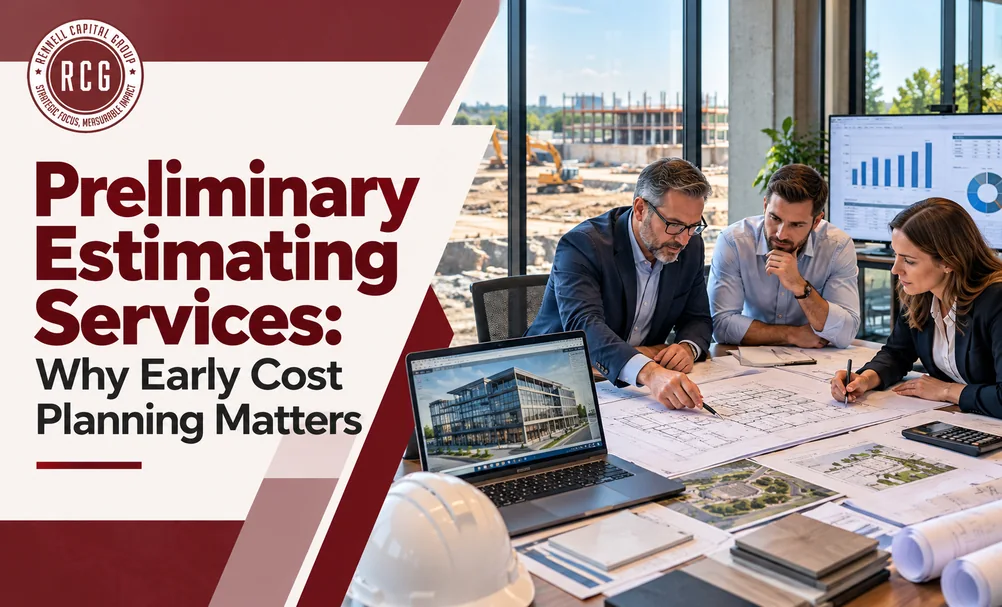
Preliminary estimating services help owners and developers understand how much a construction project may cost before the final drawings are ready. These early estimates use basic project details, initial designs, and past cost information to prepare a starting budget.
Planning a construction project involves many financial decisions. Owners need to know if they have enough money to complete the work before spending more on design, materials, or construction. Without an early cost estimate, it can be difficult to plan the budget or decide whether a project is possible.
A preliminary estimate helps project teams review costs, compare design options, and find possible budget problems early. It also helps owners plan funding and make changes while the design is still flexible. As the project moves forward, the estimate can be updated with more detailed information.
In this article, we explain what preliminary estimating services include, why early cost planning matters, and how these estimates help owners, developers, and contractors make better financial decisions throughout the construction planning process.
What Are Preliminary Estimating Services?
Preliminary estimating services provide an early construction cost forecast using whatever project information exists before detailed construction documents are finished. Owners, developers, architects, and contractors all rely on these estimates to make informed decisions during the earliest project stages.
These estimates are typically prepared when only concept plans, schematic drawings, or a general project description are available. Estimators use that limited information alongside historical cost data, benchmark pricing, and documented assumptions to build a workable budget figure. The resulting number supports early decisions about feasibility, financing, and design direction.
It’s important to understand what a preliminary estimate is not: a final bid. Contractors submit firm pricing once drawings and specifications are complete. A preliminary estimate is a planning tool, not a contractual commitment, and should always be presented alongside the assumptions behind it.
Why Early Cost Planning Matters in Construction
The earlier a cost problem is identified, the more options the project team generally has to address it. That principle sits at the heart of why preliminary estimating matters so much.
Early cost planning establishes a realistic starting budget and tests whether a proposed project is financially feasible before significant design fees are spent. It allows owners to compare design options, identify which building elements are driving cost, and plan funding accordingly. It also sets accurate expectations among stakeholders, reducing the chance of disappointment later when a more detailed estimate arrives.
Perhaps most importantly, early cost planning reduces the likelihood of costly late-stage redesign. When a budget problem surfaces after construction documents are 90% complete, the fixes are expensive and time-consuming. When that same problem surfaces during schematic design, the team can adjust scope, materials, or systems with far less disruption.
What Information Is Used for a Preliminary Construction Estimate?
Preliminary estimates draw on whatever project information is available at the time, typically including:
- Concept or schematic drawings
- Building size and project type
- Project location and site conditions
- Design narratives and outline specifications
- Major building systems under consideration
- Historical project data from comparable work
- Current market pricing for labor and materials
- Documented assumptions and contingencies
Because design information is limited at this stage, documented assumptions carry real weight. A reliable preliminary estimate makes those assumptions explicit, so the project team understands exactly what the number includes and where uncertainty remains.
How Preliminary Estimating Services Work
While every estimator has their own process, preliminary estimating generally follows a consistent path:
- Review available project information, including drawings, narratives, and program requirements.
- Define the preliminary scope based on what has been decided so far.
- Develop quantities and cost assumptions for areas where design detail is still missing.
- Apply current and historical cost data relevant to the project type and location.
- Add appropriate risk and contingency to account for remaining uncertainty.
- Prepare the preliminary budget, documented with clear assumptions and exclusions.
- Update the estimate as design information develops.
That final step matters as much as the first. A preliminary estimate isn’t a one-time deliverable; it’s a living figure meant to be refined.
Preliminary vs. Conceptual vs. Detailed Estimates
These terms get used loosely across the industry, which can create confusion. Here’s a simplified comparison:
| Estimate | Project Stage | Available Information | Main Purpose |
|---|---|---|---|
| Conceptual | Very early | Limited concept information | Feasibility |
| Preliminary | Early design | Initial or schematic information | Budget planning |
| Detailed | Developed design | Detailed drawings and specifications | Detailed cost planning |
| Bid Estimate | Bidding | Bid or construction documents | Contractor pricing |
Note that different organizations define accuracy ranges for these estimate types differently. The U.S. General Services Administration, for example, describes its own estimate classifications evolving from order-of-magnitude figures early in a project to construction estimates with +10%/-5% accuracy once drawings and specifications are 100% complete (GSA, 2026). The exact classification system matters less than understanding that accuracy improves as design information increases.
How Preliminary Estimates Help Prevent Budget Problems
A well-prepared preliminary estimate can surface issues long before they become expensive. It can reveal an unrealistic budget relative to the proposed scope, flag design choices that carry outsized cost, or highlight site conditions that will drive up expenses. It can also expose gaps in contingency planning or market escalation risk that hasn’t yet been accounted for.
Preliminary estimates help reduce budget risk, but they can’t eliminate it entirely. Conditions change, markets shift, and design decisions evolve. The value of early estimating lies in giving the team a head start on managing those risks, not a guarantee against them.
The Role of MEP/FP Costs in Preliminary Estimating
Mechanical, electrical, plumbing, and fire protection systems often represent a substantial share of total construction cost, yet they’re frequently underrepresented in early budgets because detailed engineering drawings don’t exist yet. A credible preliminary estimate still accounts for system-level planning across HVAC, electrical distribution, plumbing, fire protection, and major equipment and controls.
Skipping this step is one of the more common reasons preliminary budgets fall short once design develops. MEP/FP systems are complex enough that even approximate allowances, grounded in project type and building size, provide a far more reliable early figure than treating these systems as an afterthought.
How Preliminary Estimates Support Better Design Decisions
Early cost visibility allows design teams to compare options with real numbers attached, rather than guesswork. Building size, structural systems, HVAC approach, finishes, and energy features can all be weighed against their cost impact before decisions are locked in. That comparison is far more useful during schematic design, when changes are relatively easy, than after construction documents are finalized.
Preliminary Estimating for Project Feasibility and Funding
Owners and developers frequently use early estimates to evaluate whether a project makes financial sense at all. These figures inform feasibility studies, capital planning, internal approvals, and conversations with lenders. A preliminary estimate that shows a project exceeding available funding gives the team a chance to adjust scope or seek additional capital before design costs accumulate further.
How Preliminary Estimates Change as the Design Develops
Construction cost estimates should be updated as a project moves from early planning to final design. Each stage brings more details about materials, building systems, labor, and project needs. The GSA Facilities Standards for the Public Buildings Service provides guidance on preparing cost estimates at different design stages. As more project details become available, teams can review their numbers and improve budget accuracy. An early estimate is a useful starting point, but it should not remain the same throughout the project. Regular updates help owners track costs, make better decisions, and avoid budget problems before construction begins.
Common Mistakes in Preliminary Construction Estimating
A handful of avoidable errors tend to undermine preliminary estimates: treating an early figure as a final bid, relying on outdated cost data, ignoring project location, overlooking MEP/FP costs, using unrealistic assumptions, forgetting market escalation, applying too little contingency, failing to document assumptions clearly, and neglecting to update the estimate as the design matures.
When to Use Preliminary Estimating Services
Preliminary estimating makes sense before property acquisition or development commitments, during feasibility studies, throughout conceptual and schematic design, before seeking project approval, when comparing alternative design directions, and whenever the proposed scope and available budget don’t appear to align.
How to Choose a Preliminary Estimating Partner
Look for a partner with genuine construction estimating experience, strong MEP/FP knowledge, access to current cost data, and a track record of documenting assumptions clearly. The right partner should also be willing to update the estimate as design information develops, rather than treating it as a one-time deliverable.
Frequently Asked Questions
What are preliminary estimating services?
Preliminary estimating services provide an early construction cost forecast using the project information available before detailed drawings and specifications are complete, supporting feasibility and budget decisions.
When should a preliminary construction estimate be prepared?
These estimates are typically prepared during concept development, feasibility studies, and schematic design, before major design or financial commitments are made.
Can you prepare a preliminary estimate without complete drawings?
Yes. Estimators use concept plans, schematic drawings, historical data, and documented assumptions to build a reasonable early-stage estimate.
How accurate is a preliminary construction estimate?
Accuracy depends on design maturity, scope definition, available information, market conditions, and estimating methodology. There’s no single universal accuracy percentage that applies to every project.
What is the difference between a preliminary estimate and a detailed estimate?
A preliminary estimate relies on limited early design information, while a detailed estimate is built from completed drawings, specifications, and measured quantities.
What information is needed for a preliminary construction estimate?
Concept drawings, building size, location, design narratives, historical cost data, current market pricing, and documented assumptions all support a preliminary estimate.
Closing Thoughts
Good cost planning starts long before construction begins. Preliminary estimating services help owners and developers understand possible project costs while there is still time to make changes. This makes it easier to set realistic budgets, review design options, and avoid expensive decisions later.
An early estimate does not need complete construction drawings. It uses available project details, basic designs, past cost information, and current market prices to prepare a starting budget. As the design develops, the estimate can be updated to reflect new information and project needs.
Early cost planning also helps project teams find budget risks, compare building systems, plan funding, and make better financial decisions. It gives owners a clearer idea of what they can afford before spending more money on detailed design or construction.
Rennell Capital Group provides professional MEP/FP estimating and construction cost advisory support for owners, developers, and contractors. Our team helps review early project information, understand major cost factors, and prepare useful budget guidance for better planning.
Whether you are starting a new construction project or reviewing an early design, clear cost information can help you move forward with greater confidence.
Ready to plan your project budget? Contact Rennell Capital Group today to discuss your preliminary estimating needs.

Looking for fresh content?
Get articles and insights from our weekly newsletter.
Recent Posts
Discuss a Project today!