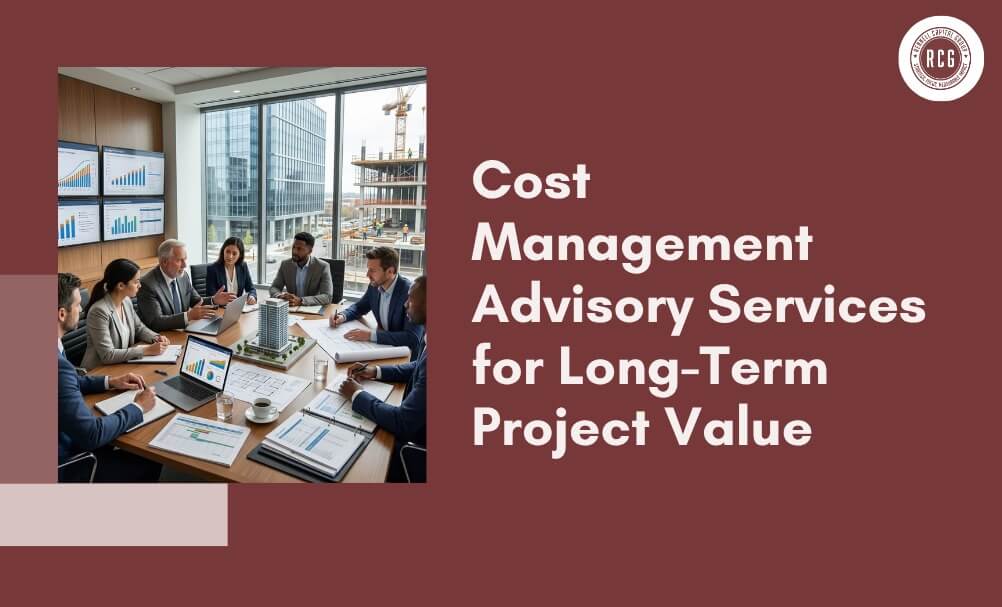
Cost management advisory services assist clients in managing project construction costs. Such advisory services provide relevant, timely costs for project teams to manage the project budget, identify financial risks, and help clients make informed project decisions.
A construction budget can be heavily revised post approval. Inflating costs can occur from several factors, including, but not limited to, procurement, design, labor, material costs, project schedule, and project scope. Cost change orders can add significant financial pressure to a budget. Further, the client post construction incurs financial obligations from energy cost, repairs, and replacements of plant and equipment.
Cost management advisors help projects staff understand costs and structure financial plans to prepare for costs and budget changes. There are several financial options available for a construction project. Cost management advisory services help structures projects in a way to protect the projects long term financial value.
This article provides information on cost management advisory services and how the engagement of a cost management advisor supports and improves project outcomes.
What Are Cost Management Advisory Services?
Cost management advisory services help owners and developers plan, review, and control construction costs throughout a project. A cost advisor gives the project team clear financial information so they can manage the budget and make better decisions.
These services can include:
- Budget planning and development
- Construction cost estimating
- Independent cost reviews
- Cost forecasting
- Risk and contingency planning
- Procurement support
- Cost tracking and reporting
- Change order reviews
- Value engineering
- Lifecycle cost analysis
A cost advisor can also compare estimates, review price changes, find possible budget risks, and track costs as the project moves forward. This helps owners understand where their money is going and what may affect the final project cost.
AACE International’s Total Cost Management Framework also explains cost management as a structured process used throughout the life of a project or asset. It connects estimating, planning, forecasting, performance tracking, and cost control to support better financial decisions.
Why Cost Management Matters Throughout the Project Lifecycle
Cost management advisory isn’t a one-time preconstruction exercise. Financial decisions arise at every phase of a project, and each one carries consequences that extend well beyond the construction period.
Early Planning
The earliest project decisions carry the most financial weight. Establishing realistic cost expectations and confirming feasibility before significant design resources are committed helps owners align ambitions with available capital. Preconstruction cost planning creates the stable financial foundation that every later phase depends on.
Design
As design evolves from concept through construction documents, cost advisors keep those decisions anchored to the budget. Catching a budget problem at the schematic design stage takes hours to resolve. Catching the same problem after bidding can cost months and significant capital. Design phase cost analysis provides the ongoing feedback loop that keeps design and budget moving together.
Preconstruction
Before construction begins, advisors validate estimates and quantities, review procurement strategies, assess cost risks, and confirm that the project is financially positioned to succeed. This phase is where assumptions get tested against real market data.
Construction
Active construction cost control requires tracking budget versus commitments, actual expenditures, and forecast-at-completion throughout the job. Variance identified early can still be managed. Variance discovered at project closeout cannot be recovered.
Operations
Construction cost is only one component of what an asset will cost over its useful life. Energy, maintenance, equipment replacement, and long-term operational expenses all flow from decisions made during design and construction. Effective cost management considers those downstream costs before they become locked in.
Core Components of Cost Management Advisory Services
Project Budget Development
A reliable budget starts with a clear scope, realistic market pricing, and an honest assessment of project objectives. Cost advisors establish that baseline early factoring in design complexity, site conditions, procurement approach, and current market conditions so that owners have accurate financial expectations before design commitments are made.
Construction Cost Estimating
Detailed cost estimating accounts for labor, materials, equipment, subcontractors, and indirect costs. At each design milestone, estimates should reflect the current state of the drawings, current market pricing, and any scope developments since the last review. Estimating that lags behind design development is one of the most common sources of budget surprises at bid time.
Cost Validation
Independent cost validation provides an objective review of quantities, pricing, scope coverage, and underlying assumptions. This is especially valuable when owners are evaluating estimates prepared by contractors or design teams, where inherent bias optimistic or conservative can affect reliability.
Cost Forecasting
Forecasting looks forward, not backward. Rather than simply reporting what has been spent, cost forecasting projects where the project will finish financially based on current commitments, anticipated changes, and known risks. Decision-makers who understand likely final costs can act on that information. Those who only see historical spending are always reacting after the fact.
Cost Risk Assessment
Every project carries financial exposure that doesn’t appear in the base estimate. Escalation risk, scope gaps, design uncertainty, procurement delays, schedule extensions, and market volatility all represent potential cost impacts. Identifying that exposure early and sizing contingencies appropriately is far more effective than discovering it during construction.
Cost Monitoring and Reporting
During construction, advisors track budget against commitments, actual costs, and forecast-at-completion on a regular basis. Clear reporting keeps owners and stakeholders informed about the project’s financial position and provides the visibility needed to make timely decisions.
Change Management
Change orders are one of the most common sources of budget erosion on construction projects. Professional cost advisory includes evaluating the financial impact of proposed design and construction changes before approval so that owners understand the full cost consequence of each decision, not just the line-item price submitted by the contractor.
Cost Management vs. Construction Cost Estimating
These two disciplines are related but distinct. Understanding the difference helps owners ensure they have the right type of support at each project stage.
| Construction Cost Estimating | Cost Management Advisory |
|---|---|
| Predicts project cost | Manages cost strategically |
| Often tied to a specific project stage | Continues across all project phases |
| Calculates quantities and pricing | Interprets and controls cost information |
| Produces an estimate | Tracks and updates budget performance |
| Supports budgeting and bidding | Supports broader financial decisions |
| Focused on construction | Considers long-term value |
Accurate estimating creates the financial baseline. Cost management uses that baseline and continually updates it to support better decisions throughout the project.
How Cost Management Advisory Services Improve Project Control
Better Cost Visibility
When cost advisory is working well, stakeholders know where capital is allocated, what has been committed, and where the project is headed financially. That clarity supports confident decision-making at every level.
Earlier Warning of Budget Problems
Variance that surfaces early can still be addressed through design adjustments, procurement changes, or scope modifications. The same variance discovered during construction typically has far fewer remedies and higher costs to resolve.
Better Forecasting
Reliable forecasting gives decision-makers a realistic view of likely final project costs. That information is essential for managing cash flow, maintaining lender relationships, and making informed go-forward decisions when challenges arise.
Stronger Change Control
Changes evaluated before approval are manageable. Changes approved without financial analysis accumulate quietly until they become significant budget problems. Professional cost management introduces discipline into that process.
Improved Accountability
When cost information is structured, current, and clearly reported, it becomes easier for owners, contractors, and consultants to understand their respective responsibilities and to identify problems before they escalate.
Managing Cost Risk Before It Impacts Project Value
Construction projects carry financial risks that don’t always appear in the base budget. The most common include scope gaps, inaccurate quantity assumptions, mid-project design changes, labor cost escalation, material price volatility, procurement delays, schedule extensions, inadequate contingency, change orders, and MEP coordination conflicts.
The critical distinction is between risk identification and reactive cost cutting. Reactive cost cutting happens under pressure, often compromising quality or long-term performance to recover short-term budget. Professional cost risk management identifies financial exposure early enough that project teams can make informed decisions whether that means adjusting scope, restructuring procurement, or building appropriate reserves into the budget.
Cost risk management is most effective when it begins before design is complete, when the range of possible outcomes is still wide and the cost of adjusting course is still low.
How Cost Management Supports Better Design Decisions
Design decisions made early lock in the majority of a project’s lifetime costs. The choice of structural system, envelope performance, mechanical approach, and finish quality all carry long-term financial consequences that extend well beyond construction.
Cost advisors work alongside owners, architects, and engineers to evaluate those decisions in financial terms. That analysis covers:
- Design alternatives and their cost implications
- Material and system selections
- Structural and MEP system comparisons
- Equipment choices and their operating cost profiles
- Constructability considerations
- Initial versus lifecycle cost trade-offs
The emphasis here is on value, not simply on selecting the least expensive option. A design decision that saves capital upfront but increases annual operating costs by a meaningful amount may not represent genuine savings over the life of the asset. Professional cost advisory brings that longer view into design-phase conversations, when the analysis still has the power to change outcomes.
Why MEP/FP Cost Management Deserves Special Attention
Mechanical, electrical, plumbing, and fire protection systems represent some of the most complex and cost-sensitive decisions on any construction project. MEP/FP scope typically accounts for a substantial portion of total construction cost and an even larger share of long-term operating expenses.
Effective MEP/FP cost management addresses:
- HVAC system selection, sizing, and distribution
- Electrical systems, lighting, and controls
- Plumbing and water heating
- Fire protection design and equipment
- System coordination across disciplines
- MEP labor costs and installation complexity
- Long-lead equipment procurement and pricing
MEP decisions made during design lock in operating costs for decades. An investment in higher-efficiency systems may carry a premium at construction but return that premium many times over through reduced energy and maintenance expenses. Conversely, MEP scope that is under-budgeted or poorly coordinated often produces the most significant change orders during construction.
RCG’s technical MEP/FP estimating expertise is directly relevant here. Unlike generic financial consulting, construction cost advisory that integrates deep MEP knowledge can evaluate these systems accurately both in terms of what they cost to build and what they will cost to operate.
How Cost Management Advisory Supports Smarter Procurement
Procurement decisions have a direct and lasting impact on project cost. Cost advisors support better procurement outcomes by:
- Comparing bids on an apples-to-apples basis across scope and inclusions
- Reviewing subcontractor quotes for gaps, exclusions, and assumptions
- Analyzing long-lead equipment pricing and delivery schedules
- Evaluating procurement timing relative to escalation risk
- Supporting buyout decisions based on current market data
Selecting the lowest bid isn’t automatically the best financial decision. A bid that excludes key scope items, relies on unrealistic labor assumptions, or carries high risk of change orders may ultimately cost more than a higher initial number with a well-defined scope. As RCG’s construction bid analysis guidance notes, meaningful bid review looks beyond the bottom-line price to labor, materials, equipment, subcontractor costs, contingencies, exclusions, and scope differences.
How Cost Management Creates Long-Term Project Value
This is where the title of this article earns its second half. Project value extends well beyond achieving the lowest construction price. A building’s true financial performance depends on decisions made across its entire life.
Initial Capital Cost
What does it cost to design and construct? This is the question most owners focus on but it’s only the first chapter.
Operating Cost
What will it cost to run the building day to day? Utilities, energy, cleaning, and facility operations repeat for the entire life of the asset. Small inefficiencies compound significantly over time.
Maintenance Cost
What ongoing spending will building systems require? Preventive maintenance investments that seem discretionary often prevent far more expensive corrective repairs later.
Replacement Cost
When will major components need replacement? HVAC equipment, roofing systems, elevators, and electrical infrastructure all have defined service lives. Budgeting for those replacements in advance rather than scrambling when systems fail is fundamental to sound asset management.
Energy Performance
How will building-system decisions affect future energy expenses? High-performance mechanical and envelope decisions can deliver meaningful operating cost reductions over a 20- or 30-year horizon.
Asset Performance
Will today’s construction choices support the building’s intended use and market value for decades? Long-term asset performance depends on the quality and durability of the decisions made during design and construction.
For a deeper look at how these factors connect, see RCG’s guide on lifecycle cost planning, which addresses total cost of ownership in detail.
Also Read: Lifecycle Cost Planning: Looking Beyond Initial Construction Costs
How Technology Improves Construction Cost Management
Modern cost management draws on a range of digital tools that improve speed, accuracy, and visibility:
- Digital estimating platforms that streamline quantity takeoffs and cost calculations
- BIM integration that links cost data directly to design model elements
- Construction cost databases that reflect current regional pricing
- Cloud-based project management platforms that connect field data to financial reporting in real time
- Forecasting dashboards that present budget, commitments, actuals, and forecast-at-completion in a single view
- Predictive analytics that use historical data to identify cost risk patterns
Technology improves the speed of analysis, the depth of data available, and the accessibility of cost information across project stakeholders. But professional judgment remains essential. Software produces numbers; experienced cost advisors interpret them, contextualize them, and translate them into actionable recommendations specific to each project’s circumstances.
When Should Owners Use Cost Management Advisory Services?
The short answer: earlier than most owners typically engage. The most common situations where professional cost advisory delivers measurable value include:
- Before acquiring or developing a property
- During project feasibility evaluation
- Before or during early design
- When establishing the initial construction budget
- During significant design development changes
- Before procurement and bidding
- When contractor proposals vary significantly from each other or from the budget
- When MEP or FP scope is technically complex
- When costs begin trending above budget during construction
- During major change-order negotiations
- When evaluating long-term capital requirements for an existing asset
Each of these moments represents a decision point where better financial information leads to a better outcome. Professional cost advisors provide that information independently, accurately, and in context.
How to Choose the Right Cost Management Advisory Partner
Not all cost advisory services offer the same depth. When evaluating potential partners, consider:
- Construction estimating expertise: Can they produce accurate, detailed estimates across project types?
- MEP/FP technical knowledge: Do they understand mechanical and electrical systems well enough to evaluate them accurately?
- Cost planning experience: Have they supported projects from early feasibility through construction completion?
- Independent analysis: Are they free from conflicts of interest with contractors or design teams?
- Quantity takeoff capability: Can they verify scope and quantities independently?
- Current market pricing knowledge: Do their estimates reflect real market conditions?
- Risk assessment experience: Can they identify and size cost risks specific to your project?
- Clear reporting: Do they present cost information in a way that supports decision-making?
- Owner-focused communication: Are they able to translate technical cost data into clear financial guidance?
Technical depth matters particularly for MEP/FP-intensive projects where system-level expertise is required to evaluate costs accurately.
Let’s Wrap This Up
Good cost management is about more than keeping construction within budget. It helps owners and developers make better financial decisions from early planning through construction and long-term ownership.
Regular cost reviews can help teams understand spending, find budget risks early, prepare better forecasts, review design choices, manage changes, and make smarter purchasing decisions. Careful MEP/FP cost planning can also improve budget accuracy for complex building systems. These steps give project teams a clearer view of costs and help reduce unwanted financial surprises.
A strong cost management plan also looks beyond today’s construction expenses. It considers how current choices may affect future maintenance, operations, repairs, and overall building value.
Rennell Capital Group provides professional MEP/FP estimating and cost advisory support for owners, developers, and project teams. We help clients understand project costs and make informed decisions with greater confidence.
Ready to improve your project’s cost planning and control? Contact Rennell Capital Group today to discuss your project.
Frequently Asked Questions
What are cost management advisory services?
Cost management advisory services provide professional guidance for planning, analyzing, monitoring, and controlling construction costs throughout a project’s lifecycle. Advisors help establish realistic budgets, evaluate cost risks, validate estimates, monitor financial performance, and support decisions that protect both project delivery and long-term asset value.
What does a construction cost management advisor do?
A construction cost management advisor develops and validates budgets, forecasts future costs, identifies financial risks, reviews change orders, supports procurement decisions, and monitors project cost performance. Their role continues across all project phases from early feasibility through construction completion rather than being limited to a single estimate at one point in time.
How does cost management improve long-term project value?
Cost management improves long-term project value by connecting construction decisions to their downstream financial consequences. Advisors evaluate not only what a project costs to build, but what it will cost to operate, maintain, and eventually replace ensuring that design and procurement decisions support strong asset performance over time, not just on opening day.
What is the difference between cost estimating and cost management?
Cost estimating predicts what a project will cost at a specific point in time. Cost management is an ongoing discipline that uses the estimate as a baseline and actively monitors, updates, and controls financial performance across all project phases. Estimating produces a number; cost management uses and continuously refines that number to support better decisions.
When should an owner hire a cost management consultant?
Owners benefit most from engaging a cost management consultant before design begins ideally during project feasibility. Earlier engagement means the advisor can influence budget development, shape design decisions, and identify risks while they are still inexpensive to address. Engaging a consultant only after bids are received limits the value they can provide.
How can cost management help prevent construction budget overruns?
Cost management helps prevent budget overruns by establishing accurate baselines, identifying risks before they materialize, maintaining current forecasts throughout construction, evaluating changes before approval, and providing the financial visibility needed to make timely course corrections. Budget problems that surface early are manageable; those discovered late in construction rarely are.
Looking for fresh content?
Get articles and insights from our weekly newsletter.
Recent Posts
Discuss a Project today!