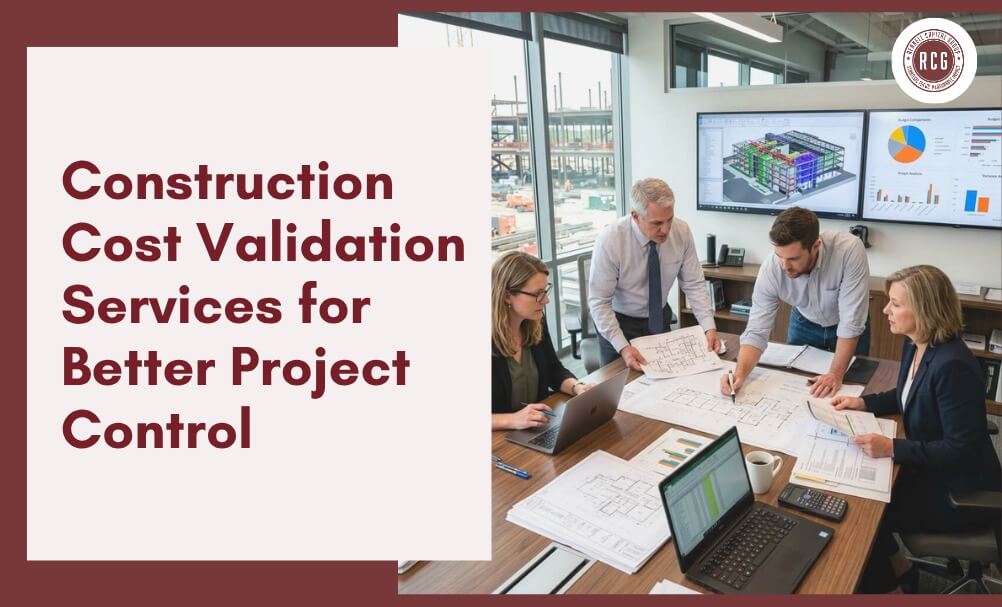
A construction budget can be detailed, well-organized, and still be wrong. Pages of line items and carefully labeled categories create a sense of confidence but a polished format doesn’t guarantee accurate numbers. Hidden beneath that structure, there may be missing scope, incorrect quantities, outdated unit pricing, unrealistic labor assumptions, insufficient contingencies, duplicate costs, or unclear allowances.
Approving an estimate without validating its assumptions exposes owners, developers, and contractors to financial risk that only grows as the project moves forward. Design decisions get locked in. Contracts get signed. And by the time the gaps surface during construction, the cost to correct them is far higher than it would have been at the planning stage.
That’s where construction cost validation services come in. Validation isn’t about creating a new estimate from scratch it’s about stress-testing the one you already have. It’s the structured, independent review that answers the question every owner should be asking before they commit capital: Is this budget actually right?
This post explains what construction cost validation services are, what they review, the problems they catch, and when to use them across the project lifecycle.
What Are Construction Cost Validation Services?
Construction cost validation services review project estimates, quantities, pricing, scope, labor assumptions, allowances, and contingencies to determine whether a construction budget is complete, realistic, and aligned with current project conditions.
More specifically, cost validation is an independent or structured review of an existing estimate or budget. The goal isn’t to produce a competing number it’s to determine whether the numbers already on the table are reasonable, complete, supported by current data, and properly tied to the defined project scope.
A thorough cost validation process typically covers:
- Estimate review and documentation
- Scope verification against drawings and specifications
- Quantity checking for materials and systems
- Labor rate and productivity validation
- Material and equipment pricing
- Subcontractor quote analysis
- Review of allowances and contingencies
- Assessment of current market conditions
The output is a clear picture of whether the budget can be trusted and where it can’t.
Why Construction Cost Validation Matters for Project Control
Effective construction cost control begins with a sound original budget. That’s not just a planning principle it’s the foundation every later phase of cost management is built on. If the baseline is flawed, every forecast, approval, and contingency decision made against it is flawed too.
Construction cost validation connects directly to project control in several critical ways:
- It establishes a reliable cost baseline. Teams can’t manage against a number they can’t trust.
- It detects problems before commitments are made. Catching a scope gap during design development is far less expensive than discovering it during construction.
- It improves budget transparency. Stakeholders understand what the numbers include and why.
- It supports owner decision-making. Clear, validated cost data allows owners to weigh trade-offs with confidence.
- It reduces financial uncertainty. Identified risks can be planned for. Unidentified ones become change orders.
Construction cost verification isn’t an accounting exercise. It’s a project management tool that protects the financial integrity of the entire delivery process.
Construction Cost Validation vs. Construction Estimating
These two processes are closely related but serve different purposes. Confusing them is one of the most common misunderstandings in preconstruction planning.
| Construction Estimating | Cost Validation |
|---|---|
| Develops an estimate | Reviews an existing estimate |
| Predicts project costs | Tests whether costs are reasonable |
| Builds quantities and pricing | Checks quantities and pricing |
| Establishes the initial budget | Confirms budget reliability |
| Often prepared internally | Can provide independent review |
The two processes complement each other rather than replace each other. An internal estimator builds the numbers; a construction cost validation review confirms whether those numbers hold up.
What Is Reviewed During Construction Cost Validation?
This is where the real work happens. A rigorous cost validation process examines every major component of the budget.
Project Scope and Documentation
Validation begins with the project documents: drawings, specifications, addenda, scope requirements, and any noted exclusions. Before a single number is reviewed, the reviewer must confirm that the estimate is actually pricing the right project. Scope misalignment between documents and the estimate is one of the most common and most costly sources of budget error.
Quantity Takeoffs
Accurate quantities are the foundation of any reliable estimate. Unreliable takeoffs weaken every pricing calculation built on them. As RCG’s construction quantity takeoff guidance makes clear, the connection between accurate quantities, budgets, and bid reliability is direct. During validation, key quantities for materials, systems, and equipment are verified against current drawings to confirm they reflect what the project actually requires.
Labor Assumptions
Labor validation reviews rates, crew productivity assumptions, installation hours, and the complexity of specific work scopes. Labor is frequently the area where estimates drift furthest from reality, especially on projects with specialized trades or tight schedules.
Material and Equipment Pricing
Pricing is compared against current market conditions, available supplier quotations, historical project data, and reasonable escalation expectations. An estimate priced against data from 18 months ago may look complete and still be significantly wrong.
Subcontractor Quotes
Subcontractor pricing is reviewed for scope coverage, exclusions, alternates, and significant differences between competing quotes. Quote differences don’t always mean one subcontractor is wrong; sometimes they signal a scope gap that no one has addressed.
Allowances and Contingencies
The review determines whether adequate provisions exist for uncertainty. Insufficient contingency is one of the most reliably predictable causes of budget overruns on complex or renovation projects.
Common Cost Problems a Validation Review Can Identify
Missing Scope
Work that’s in the drawings but absent from the estimate. This creates a real budget shortfall that will surface as a change order during construction at a much higher cost than if it had been caught during design.
Duplicate Costs
The same scope priced twice across different divisions or trade packages. Duplicates inflate the apparent budget and distort cost allocation decisions.
Incorrect Quantities
Measurement errors, unit conversion mistakes, or outdated drawing references can cause significant quantity inaccuracies. Small errors compound dramatically once unit pricing is applied at scale.
Outdated Unit Pricing
Material and labor markets shift. An estimate using pricing from a prior project cycle may be substantially understated for copper, steel, ductwork, or skilled labor, particularly in high-demand markets.
Unrealistic Labor Productivity
Productivity assumptions that work for straightforward new construction don’t apply to occupied renovations, tight urban sites, or phased projects. When productivity rates are wrong, labor costs are wrong.
Insufficient Contingency
A 5% contingency on a complex renovation with undefined existing conditions is not adequate. Construction cost analysis should ensure contingency levels actually reflect project risk.
Inconsistent Contractor or Subcontractor Quotes
When two subcontractors price the same scope 30% apart, one of them has likely misread the drawings or priced something different entirely. Validation surfaces these inconsistencies before they become contract problems.
How Construction Cost Validation Services Improve Budget Accuracy
Validation creates a more defensible financial baseline. When the review is complete, the team has documented evidence that the budget numbers have been examined, assumptions have been tested, and gaps have been identified and addressed.
The practical results include:
- More accurate budgets that reflect actual scope, quantities, and current pricing
- Better forecasting because the starting point is reliable
- Stronger cost controls throughout construction
- Reduced financial uncertainty for owners and lenders
- More informed project approvals based on confirmed rather than assumed data
- Improved negotiations with contractors and subcontractors
It’s important to be clear about what validation can and cannot do. It improves the quality of the financial information available before commitments are made. It identifies avoidable risk earlier. But it doesn’t eliminate all uncertainty no process can. Its real value is ensuring that the risks that remain are known, documented, and planned for.
The Role of Independent Cost Validation
An independent cost review adds a layer of objectivity that internal reviews, however thorough, cannot fully provide. When the same team that built the estimate also validates it, blind spots remain blind.
An independent reviewer brings:
- A second perspective unconstrained by the assumptions baked into the original estimate
- Objective cost assessment against current market benchmarks
- Independent construction cost benchmarking from comparable projects
- Assumption testing that challenges figures the original team may have accepted without scrutiny
- Additional quality assurance across quantities, pricing, and scope coverage
- Better owner visibility into where budget risks actually sit
As RCG’s independent cost estimator guidance explains, independent review gives owners an objective baseline for budget validation and negotiation, and a foundation for confident decision-making rather than hopeful assumptions.
When Should Construction Costs Be Validated?
Cost validation isn’t a one-time event. The budget evolves as design progresses, and validation should too. As RCG’s preconstruction cost planning framework demonstrates, estimates become more detailed and more consequential at every design milestone.
Concept Design
Validate the feasibility assumptions that underpin the earliest budget range. At this stage, the goal is directional accuracy: confirming the project is financially viable before significant design investment is made.
Schematic Design
Compare the evolving design against the established budget. As system types and building configurations take shape, cost implications become more defined and more verifiable.
Design Development
Validate increasingly detailed quantities and system selections. This is often the last practical point to make significant scope or design adjustments before costs become difficult to change.
Construction Documents
Review the detailed estimate against completed drawings before procurement or bidding begins. According to the U.S. General Services Administration, structured cost review at this stage is a recognized best practice in professional project cost management.
Before Contract Award
Compare contractor and subcontractor proposals against the validated cost baseline. Proposals that diverge significantly from the baseline high or low warrant investigation before contracts are signed.
Why MEP Cost Validation Deserves Special Attention
Mechanical, electrical, plumbing, and fire protection systems consistently represent 30 to 45 percent of total construction costs on commercial projects and significantly more in healthcare, laboratory, and data center environments. That financial exposure makes MEP budget estimating one of the highest-risk areas in any project budget.
MEP cost validation reviews:
- HVAC systems and equipment
- Electrical distribution and service
- Plumbing and domestic water systems
- Fire protection and suppression
- Major equipment selections and specifications
- Controls and automation systems
- MEP labor rates and installation productivity
Complex MEP scopes create substantial budget exposure when quantities, specifications, or coordination requirements are misunderstood. A missing fire protection system, an undersized electrical service, or incorrect ductwork quantities can produce change orders that dwarf the cost of proper validation.
How Cost Validation Supports Value Engineering
Cost validation and value engineering are related but distinct processes, and understanding the difference matters.
Cost validation identifies where the money is going. Value engineering evaluates whether there is a better way to achieve the required performance.
Validation creates the financial transparency that makes meaningful value engineering possible. Once the team knows which systems and scopes carry the highest cost, they can evaluate alternatives systematically, comparing cost impacts, assessing constructability, and protecting design intent rather than making cuts indiscriminately under budget pressure.
This distinction is important for owners. Value engineering done without validated cost data often results in scope reductions that save money on paper but fail to address the real source of the budget problem.
Best Practices for Reliable Construction Cost Validation
A disciplined cost validation process follows a consistent set of practices:
- Use current, complete drawings as the basis for review
- Define scope clearly and document assumptions explicitly
- Verify quantities on high-value and high-risk items independently
- Apply current market pricing, not historical benchmarks
- Document all assumptions and note where data gaps exist
- Compare against historical data from comparable project types
- Review contingency levels relative to actual project risk
- Reconcile differences between the estimate and the validation findings
- Update the validation as design changes a point-in-time review goes stale quickly
Who Benefits From Construction Cost Validation Services?
Project Owners
Better visibility into whether the budget can be trusted before capital is committed. Validation gives owners the confidence to approve, adjust, or pause based on reliable information.
Developers
More accurate feasibility analysis and investment decisions. Validated cost data strengthens the financial case for lenders and equity partners.
Contractors
Stronger estimate review and cost awareness before bids are submitted. Internal validation helps contractors protect margins and reduce bid risk.
Investors and Lenders
More reliable project-cost information to support financing decisions. An independently validated budget is a materially stronger document than one that has never been reviewed.
Design Teams
Earlier feedback on the cost impact of design decisions before those decisions become expensive to change.
The Bottom Line
Construction cost control starts with knowing whether the underlying budget can be trusted. A detailed estimate that has never been validated is a financial assumption, not a financial plan.
Reliable construction cost validation requires accurate quantities, complete scope coverage, current market pricing, realistic labor assumptions, and appropriate contingencies, all reviewed against the actual project documents by someone with the expertise to identify where the numbers don’t hold up. Add an independent review, and you have a validated cost baseline that owners, lenders, and project teams can actually rely on.
If your next project needs that level of financial certainty, Rennell Capital Group provides construction cost validation services, MEP/FP estimating, preconstruction cost analysis, and professional construction consulting built on real data and current market knowledge. The goal isn’t just a reviewed budget it’s the confidence to make better decisions at every stage of the project.
Frequently Asked Questions
What are construction cost validation services?
Construction cost validation services are structured reviews of an existing construction estimate or budget. They verify that quantities are accurate, scope is complete, pricing reflects current market conditions, labor assumptions are realistic, and contingencies are appropriate for the level of project risk.
Why should construction estimates be independently validated?
Internal teams that prepare an estimate can develop blind spots around their own assumptions. An independent reviewer brings objective benchmarking, unbiased assessment of quantities and pricing, and a fresh perspective that helps owners confirm whether the budget reflects reality or reflects optimism.
What is included in a construction cost validation review?
A thorough review covers project scope and documentation, quantity takeoffs, labor rate and productivity assumptions, material and equipment pricing, subcontractor quotes, allowances, and contingencies all assessed against current drawings and market conditions.
When should project costs be validated?
Costs should be validated at multiple points: concept design, schematic design, design development, construction documents, and before contract award. A single validation at one stage is not sufficient because design changes alter cost assumptions throughout the preconstruction process.
How does cost validation help prevent construction budget overruns?
Validation identifies missing scope, incorrect quantities, outdated pricing, unrealistic labor assumptions, and insufficient contingencies before commitments are made. Catching these issues during design costs far less than correcting them during construction and reduces the likelihood of change orders that erode project budgets.

Looking for fresh content?
Get articles and insights from our weekly newsletter.
Recent Posts
Discuss a Project today!